
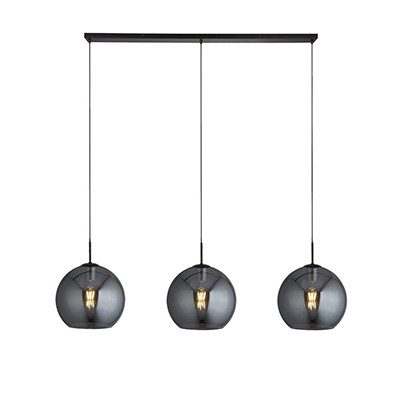
Bar Pendants
Even light along a length
Bar pendants spread three or more lights along a horizontal bar — the right choice over a kitchen island, a long dining table, or any surface where a single pendant would leave half the space dark.
Where bar pendants earn their place
A bar pendant does one thing a single pendant can't: throw even light along a length. Three, four or five bulbs spaced along a horizontal bar cover the full surface beneath — no bright spot in the middle, no dark ends.
The three most common applications:
Kitchen islands — bar pendants are the default over an island. Three lights along a 1.6–2m bar gives even task light across the full worktop, with a decorative presence that a flush ceiling fitting can't match.
Long dining tables — for tables over 1.8m, a single pendant leaves the ends of the table in shadow. A three- or five-light bar pendant puts light along the full length.
Hallways and bars — narrow spaces where you want a single continuous run of light rather than a series of separate fittings.
Sizing and spacing
The bar should be roughly 60–75% of the length of the surface below. A 2.4m kitchen island suits a 1.5–1.8m bar pendant; a 2m dining table suits a 1.2–1.5m bar. Too short and the ends of the table go dark; too long and the bar overpowers the room.
Three-light bars are the most common. Five-light bars suit longer tables and wider islands. Centre the bar on the surface below, not the room — if the island or table isn't centred, the pendant shouldn't be either.
Hanging height
Bottom of the shades should sit 75–90cm above the island or tabletop — high enough not to block sightlines across the surface, low enough to put the light exactly where it's needed. For kitchen islands where people sit at barstools, lean towards the higher end (85–90cm) so the light doesn't glare in their eyes when they're seated.
Bulbs, wiring and installation
Most bar pendants take multiple E27 or E14 bulbs, controlled as a single circuit. The whole bar switches on together — there's rarely independent control of individual bulbs. Warm white (2700K) works for dining; 3000–4000K is better over a kitchen island where the light is doing real task work.
Bar pendants are heavier than single pendants and often longer than the existing ceiling rose. Installation should be done by an electrician — the new fitting usually needs a proper ceiling plate or a rewire of the rose position to centre the bar over the island or table correctly.
Frequently asked questions
How many lights should a bar pendant have?
Three is the default for most islands and tables. Five works for longer surfaces (over 2m). For very long runs, consider two separate three-light bars rather than a single extra-long bar — easier to install and more even coverage.
Can I centre a bar pendant on my ceiling rose?
Not usually — the bar should centre on the island or table below, not the existing rose. Most bar pendants ship with a longer-than-needed suspension cable that can be offset from the rose. For a larger offset, an electrician can move or extend the rose position.
Are bar pendants dimmable?
Most are, with dimmable LED bulbs and a trailing-edge LED dimmer. Because all bulbs on the bar share one circuit, they dim together. For scene control (bright for cooking, dim for dining), pair the circuit with a smart dimmer or smart bulbs.
What's the difference between a bar pendant and a linear suspension?
A linear suspension is a continuous illuminated bar with integrated LED strip inside — one long line of light rather than distinct bulbs. A bar pendant has individual lights along a mounting bar. Linear suspensions are cleaner and more modern; bar pendants have more decorative presence.
Related categories
- Pendant Lights — the full pendant range
- Cluster Pendants — multiple lights dropped vertically from one rose
- Single Light Pendants — one light per rose, the default for most rooms
- Linear Lighting — continuous LED bar suspensions
- Smart Bar Pendants — app-controlled bar pendants with tuneable white