
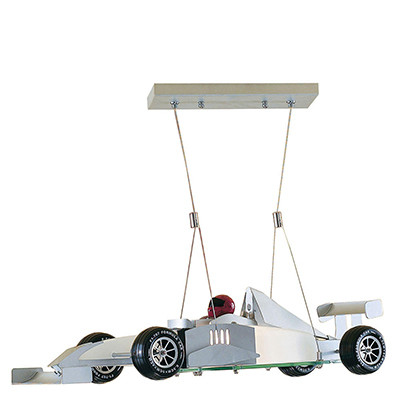
Kids Lighting
Lighting designed for children's rooms
Playful ceiling lights, nightlights, themed pendants and dimmable lamps for bedrooms, playrooms and nurseries. Safe, practical and actually designed with children in mind.
What makes a light "kids lighting"
Three things, usually together:
Safety — no exposed bulbs at head height, no sharp edges, no easily-accessible small parts on floor-level fittings. Ceiling-mounted designs are inherently safer than floor or low-table lamps for young children.
Playful design — themed, colourful or character-led fittings that children respond to. Shape, colour and subject matter matter much more in a child's bedroom than in an adult's.
Appropriate output — brightness that works for both play (higher output) and wind-down (lower, warmer). Dimmable fittings or separate nightlights cover this.
By age group
Nurseries and babies — soft, dimmed ambient light rather than bright overhead. A central ceiling fitting paired with a dimmable wall night-light lets you do 3am feeds without flooding the room with light. Colour-change or warm-white smart bulbs let you adjust to whatever works for the baby.
Toddlers and young children (2–6) — themed ceiling fittings that children recognise and respond to. Animals, space, transport, princesses, superheroes — the theme matters more than the technical spec at this age. A nightlight on a timer or dusk-till-dawn sensor helps with the dark.
Older children (6–12) — brighter general room lighting for reading and homework, plus a dedicated desk lamp for task work. Decorative pendants or novelty ceiling fittings work if they suit the child's interests. Colour-change smart bulbs are popular — the child can set the colour themselves for bedtime stories or playtime.
Teenagers (12+) — closer to adult lighting needs. Dimmable ambient lighting, a proper desk lamp, plus LED strips or colour-change feature lighting if the teen wants mood/scene control.
Fitting types for children's rooms
Themed ceiling pendants — shade-style pendants with character designs or colourful shades. Central ambient source, easily updated as the child's tastes change (shade-only for some, full-pendant for others).
Nightlights — low-output bedside or wall-mounted lights for overnight use. Often colour-change, with a soft warm option for sleep.
Desk lamps — task lighting for homework, drawing and reading. Adjustable arms, dimmable output, clear bright task light.
Wall lights — bedside readers or over-bed fittings, safer than free-standing floor lamps near small children.
Novelty and feature lighting — illuminated words, LED neon signs, lit-up feature elements for older children's and teens' rooms.
Smart lighting for children's rooms
Colour-change smart bulbs are popular in children's rooms. A single standard E27 bulb becomes a colour-change, dimmable, schedulable fitting — useful for gradual wake-up alarms, automated bedtime dimming, and letting children choose their own "story-time purple" or "superhero red" scenes. See the colour-change and smart bulb ranges.
Tuneable-white smart bulbs are also worth considering — shifting from bright cool light during play to warm amber for bedtime, and back again in the morning.
Safety considerations
A few practical notes:
No exposed filament or low-mounted bulbs — children's rooms benefit from fittings with enclosed shades or diffusers where little fingers can't reach hot bulbs. LED bulbs run cool but the principle still applies to glass and sharp components.
Cord management on floor and table lamps — if using floor or table lamps in a child's room, keep cords tucked behind furniture and use cable clips or routing. Trailing cords are a hazard for young children.
Dimmable rather than always-bright — dimming lets you use the same fitting for homework, play and wind-down. This is especially valuable for ceiling fittings that can't easily be swapped.
Night-light positioning — wall-mounted night-lights are safer than plug-in night-lights within a child's reach. Automatic dusk-till-dawn night-lights save worrying about switching them on at bedtime.
Frequently asked questions
Are LED bulbs safe for children's rooms?
Yes, and often safer than older incandescent or halogen bulbs. LEDs run cool (minimal burn risk), don't contain mercury like CFLs, and last much longer so there's less need to access the fitting. Standard E27 or E14 LEDs are fine in any kids-lighting fitting with the matching cap.
What colour temperature is best for children's rooms?
Tuneable-white is ideal — warm (2700K) for wind-down and bedtime, cooler (3500–4000K) for homework and play. If you can't have tuneable white, default to 2700K warm white — easier on young eyes and better for evening sleep cues.
Should children's rooms have dimmable lights?
Strongly recommended. Dimming lets one fitting serve multiple purposes — bright enough for homework, dim enough for story time, warm enough for sleep. Pair a dimmable LED bulb with a compatible dimmer, or use a smart bulb with app-based dimming.
Are night-lights safe to leave on all night?
Modern LED night-lights use negligible power and run cool, so yes — running them continuously overnight is safe and inexpensive. Look for night-lights with automatic dusk-till-dawn sensors so they only run when the room is dark.
Related categories
- Smart Light Bulbs — colour-change and tuneable-white bulbs for kids' rooms
- Colour-Change Lighting — RGB smart lighting for children and teens
- Wall Lights — wall-mounted bedside and over-bed lights
- Pendant Lights — central ceiling-light range
- Table Lamps — bedside and desk lamps