
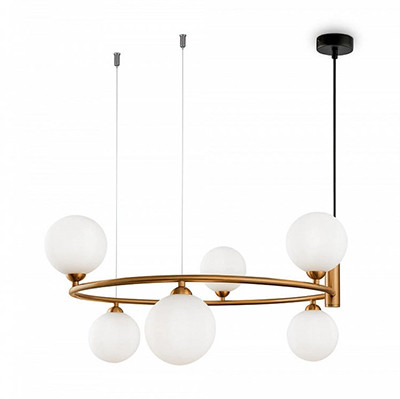
Modern Pendant
Clean lines, considered materials, zero fuss
Modern pendants — stripped-back, sculptural, material-led. The pendant range for homes where the fittings are part of the design, not a decorative flourish.
What "modern" means in pendant lighting
"Modern" in lighting is a style attitude, not a specific shape. Modern pendants strip back ornament, favour strong material choices, and let the form of the fitting carry the design weight — rather than relying on decorative detailing. Where a traditional pendant might use scrollwork, crystal drops or ornate metalwork, a modern pendant uses a clean line, a single sculptural gesture, or the raw character of the material itself.
The modern pendant range here covers several sub-styles, all sharing that stripped-back attitude:
Minimal and geometric
Single-gesture designs — a clean glass globe, a simple metal cone, a bare filament bulb on an elegant cord. The lighting equivalent of unstructured tailoring: nothing extra.
Industrial
Exposed metal, raw finishes, cage shades, enamel domes. Originally factory lighting, now firmly part of the modern domestic vocabulary. Suits loft conversions, warehouse-style kitchens, and open-plan spaces.
Scandinavian
Light wood, off-white finishes, soft curves, paper lanterns. Less assertive than industrial, warmer than strict minimalism. Made for Scandi-influenced interiors and apartments. See the full Scandinavian style range.
Sculptural and architectural
Pendants where the form is the design feature — rings, halos, abstract metalwork, oversized geometric forms. Sit alongside architectural furniture rather than period pieces.
Material-led
Designs where the primary decision is the material: brass patina, matte black metal, frosted glass, concrete, woven rattan, aged bronze. The finish is the design.
Where modern pendants fit
Modern interiors, new-builds, open-plan living, apartments, and any room where the architecture is more about line and volume than cornice and moulding. Modern pendants also work well in renovated period properties where the owner wants a deliberate contrast between old architecture and modern fittings — a common and successful design strategy.
They sit less comfortably in strictly traditional interiors. For period rooms, chandeliers, shaded pendants and traditional lighting tend to work better.
Integrated LED vs replaceable bulb
The modern pendant range splits roughly down the middle between fittings with integrated LEDs (slim, clean-line, no visible bulb) and fittings with exposed bulb holders (industrial cages, filament pendants, Edison bulbs). Both are valid modern choices — the integrated LED form tends to skew more architectural, the exposed bulb more industrial.
Integrated-LED pendants typically last 25,000+ hours and aren't bulb-swappable; the fitting is replaced when the LED fails. Exposed-bulb pendants give you ongoing flexibility — swap to a warmer bulb, to a smart bulb, to a higher output — without changing the fitting.
Frequently asked questions
How do I know if a pendant is "modern"?
Strip-back is the clearest signal. If the pendant is dominated by a single form, a single material, or a single gesture — rather than multiple decorative layers — it's almost certainly in the modern category. Ornate scrollwork, crystal detailing and candle-arm branches push it towards traditional or chandelier territory.
Can I mix modern pendants with traditional furniture?
Yes, and often successfully. A modern pendant as a deliberate contrast against period architecture (cornicing, panelled walls, antique furniture) is a recognised design strategy. The risk is doing it accidentally — mixing a modern pendant with a half-traditional scheme usually reads as unfinished rather than intentional.
Are modern pendants dimmable?
Most are. Exposed-bulb pendants dim via the bulb (dimmable LED + compatible dimmer). Integrated-LED pendants dim via their driver and need a compatible LED dimmer — check the product page.
Do modern pendants work in small rooms?
Yes — in fact, their stripped-back forms often work better in smaller rooms than ornate fittings, which can overwhelm a small space. Pick a proportionate size and keep the style cohesive with the rest of the room.
Related categories
- Pendant Lights — the full pendant range
- Ringed Pendants — circular and halo modern pendants
- Feature Pendants — large statement modern pendants
- Single Light Pendants — modern pendants in the single-light format
- Modern Lighting — all modern fittings across the range
- Scandinavian Style — Scandi-specific modern pendants