
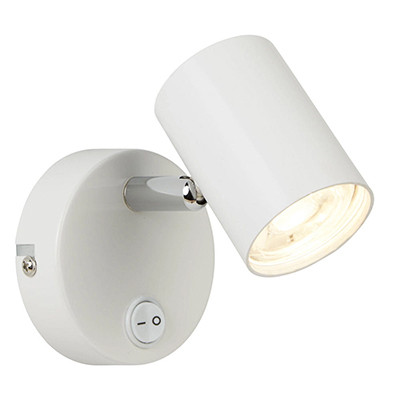
Spotlight
Directional light where you need it
Interior spotlights and track systems aim focused beams of light at specific tasks, features or zones. Kitchens, studies, utility rooms, display areas — anywhere general ceiling light isn't directional enough.
When a spotlight beats a general ceiling light
Ceiling lights flood a room with even ambient light. That's fine for general living — but for specific jobs, you want light pointing at the thing you're actually doing. Reading a recipe at a kitchen island. Working at a desk. Washing up at the sink. Highlighting a picture or a shelved display. A general ceiling fitting throws light everywhere; a spotlight throws it where you need it.
The most common interior applications:
Kitchens — spotlights above the worktop, aimed to light the work surface rather than the person standing at it. Usually installed as arrays of fixed or adjustable spots, or as a track system.
Home offices and studies — adjustable spotlights that can be aimed at a desk, a bookshelf, or a pinboard as needed.
Display and feature lighting — single directional spots picking out artwork, sculpture, collections on open shelving.
Utility rooms and pantries — functional task light where ambient ceiling light would cast shadows into corners and cupboards.
Hallways with artwork — small spots aimed along a hallway to wash light onto pictures or architectural features.
Fixed, adjustable and track — three ways to mount
Fixed spotlights aim straight down from the ceiling. Simple, reliable, the right choice when you know exactly where the light should go. Usually mounted in arrays for even coverage.
Adjustable-head spotlights — the head tilts within the housing so you can aim the beam after install. Useful for rooms where the target might change (different workstations, rearranged furniture) or where trial-and-error positioning matters.
Track systems — a long track mounted to the ceiling or wall, with multiple spotlight heads that slide along the track and can be positioned anywhere along its length. The most flexible spotlight format — ideal for kitchens, studios, galleries and display areas where positioning needs are likely to change over time.
Multi-head spotlight bars — two, three or four adjustable heads on a single mounting base. Similar to a track in effect but on a fixed mounting point. Good for rooms where you need directional flexibility from a single fixing.
Bulbs and beam angles
Most interior spotlights use GU10 bulbs — a 240V mains-voltage spotlight bulb with a twist-lock bi-pin base. Widely available, easy to swap, available in warm/cool colour temperatures, dimmable and smart variants. The dominant bulb type for interior spotlights.
Some older and commercial spotlights use MR16 (GU5.3) bulbs, which are 12V and need a transformer. Being phased out in most domestic use, though still available.
A growing proportion of modern spotlights use integrated LEDs, where the LED is built into the fitting and can't be replaced. Slimmer form factor, longer life, often tuneable white.
Beam angle matters. Narrow beams (15–25°) concentrate light on a specific target — artwork, a small feature. Wider beams (36–60°) suit general task lighting where you want broader coverage. Check the product page for the beam angle before ordering.
Installation
Surface-mount spotlights install much like any ceiling fitting — replacing a like-for-like is DIY with the power off, new installations need an electrician. Recessed spotlights (cut into the ceiling) require more structural work.
For bathroom applications, use only IP-rated fittings from the bathroom spotlight range — standard interior spotlights don't meet bathroom zone requirements.
Frequently asked questions
What bulb does a spotlight take?
Most take GU10 (a mains-voltage bi-pin spotlight bulb, available widely in warm/cool white and dimmable). Older fittings may take MR16 (12V, needs a transformer). Some modern fittings use integrated LEDs that can't be swapped. Check the product page.
Can I install spotlights in a bathroom?
Only IP-rated ones. Standard interior spotlights are not safe or compliant in bathroom zones. Use the bathroom spotlight range, which contains only IP44/IP65-rated fittings.
What's the difference between a spotlight and a downlight?
The terms overlap. Generally: a downlight is a ceiling-mounted fixed-direction spotlight, usually recessed into the ceiling. A spotlight is a broader term covering both recessed and surface-mount, fixed and adjustable fittings. Our recessed downlights are a subset of spotlights.
How many spotlights do I need for my kitchen?
Aim for one spotlight per 1–1.5m² of ceiling area. A 3m x 4m (12m²) kitchen typically takes 8–10 spotlights, spaced evenly with some positioned over worktops and the island. Avoid clustering spots in the room's centre; spread them across the whole ceiling for even coverage.
Related categories
- Ceiling Lights — general ambient ceiling lighting
- Recessed Downlights — cut-in spotlight alternatives
- Surface Downlights — surface-mount spotlight alternatives
- Bathroom Spotlights — IP-rated spotlights for bathrooms
- Smart Spotlights — app-controlled spotlight alternatives
- Under Cabinet Lights — dedicated worktop task lighting