
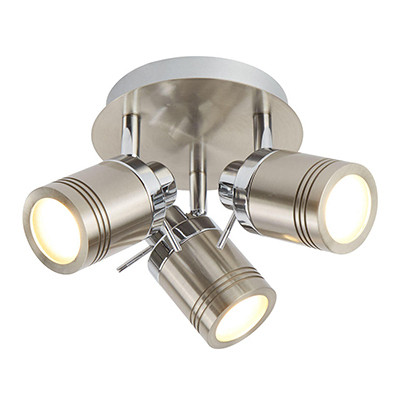
Bathroom Spotlight
IP-rated downlights for bathroom ceilings
Directional and recessed spotlights built for bathroom zones. Arrays across the ceiling for even coverage, or targeted spots over specific areas — all IP-rated for safe installation.
Why recessed downlights dominate modern bathrooms
A recessed downlight array is the cleanest lighting solution for most modern bathrooms — no visible fitting hanging below the ceiling, no shadow lines, even light distribution across the whole room. Every bathroom spotlight in this range is IP-rated for bathroom zones, typically IP65 for direct-above-shower use and IP44 for wider ceiling placement. For the zone primer, see the bathroom lighting parent page.
Array layout — getting even coverage
The goal with a downlight array is even, shadow-free light across the whole bathroom. The standard approach:
Density — aim for one downlight per 1–1.5m² of ceiling area. A 2m x 3m bathroom (6m²) typically takes 4–6 downlights; a larger 3m x 4m (12m²) bathroom takes 8–10.
Grid layout — space downlights evenly across the ceiling rather than clustering them around the centre. Keep 70–90cm between adjacent downlights and at least 30–40cm from the wall edge.
Zone-specific placement — downlights directly above the shower or bath must be IP65. Downlights over the basin and vanity should be IP44 minimum. Downlights in the outside-zones area can be IP44 (recommended) or standard indoor rating (less common, but technically compliant).
Directional spotlights vs fixed downlights
Fixed downlights throw light straight down from the ceiling. The most common and versatile option for bathrooms — simple, sealed, good for even array coverage. Fixed beam angles typically range from 38° (spot) to 60° (flood).
Adjustable / directional downlights tilt within their housing, letting you aim the light at a specific feature — artwork in the bathroom, a towel rail, a freestanding bath. Useful for larger or design-led bathrooms where accent lighting matters; overkill for small practical bathrooms.
GU10 replaceable vs integrated LED
Two dominant technologies. Each has trade-offs:
GU10 downlights use a replaceable GU10 bulb inside an IP-rated fitting. You can change the bulb (warm/cool, dimmable/non-dimmable, smart bulb) without touching the fitting. Slightly bulkier than integrated-LED equivalents.
Integrated-LED downlights have the LED built into the fitting itself. Typically slimmer, cleaner-looking, and often available with tuneable-white or colour-change options. When the LED eventually fails (25,000+ hours), the fitting is replaced — not the LED swapped.
For most modern bathrooms, integrated LED is the cleaner choice. For bathrooms where you want long-term flexibility on bulb type, GU10 fittings preserve that option.
Fire-rated downlights for upstairs bathrooms
If the bathroom is on an upper floor with a habitable room below, the downlights cut through the fire-resistant ceiling membrane and need to be fire-rated to maintain that protection. Fire-rated downlights have intumescent materials that expand in heat, sealing the opening. Look for a fire-rating label (30, 60 or 90 minutes) on the product page. Most bathroom spotlights in this range are fire-rated as standard.
Colour temperature and dimming
3000K is the comfortable default for bathroom downlights — warm-neutral, easy in the morning, not too clinical in the evening. 4000K works for larger bathrooms or where you want a cleaner, more functional feel.
Dimming works but the wall dimmer cannot be inside the bathroom zones. Either mount the dimmer outside the bathroom door, or pick smart downlights with app/voice dimming built in.
Frequently asked questions
How many downlights do I need?
Aim for one downlight per 1–1.5m² of ceiling area, evenly spaced. A 2m x 3m bathroom typically takes 4–6 downlights; larger bathrooms scale up proportionately. Avoid clustering downlights only around the centre — even grid spacing gives better coverage.
What IP rating do I need?
IP65 for downlights directly above the bath or shower (Zone 1). IP44 for downlights over the basin (Zone 2) and in the outside-zones area. If in doubt, IP65 is safe everywhere above Zone 0 and worth specifying for the whole array for simplicity.
Do I need fire-rated downlights?
Yes if the bathroom is on an upper floor above a habitable room (bedroom, living room, kitchen). Fire-rated downlights maintain the ceiling's fire resistance by sealing the opening when heated. If the bathroom is on a ground floor above a garage or unheated space, fire-rating may not be required — check with your electrician.
Can I replace GU10 bulbs myself?
Yes, with the power off at the consumer unit. GU10 bulbs twist out of the fitting like a quarter-turn socket. For integrated-LED downlights, there's no bulb to swap — when the LED eventually fails, the whole fitting is replaced by an electrician.
What's the difference between a downlight and a spotlight?
A downlight throws light straight down from the ceiling in a fixed direction. A spotlight is directional — the head tilts within the fitting so you can aim the light at a specific target. Most bathroom recessed fittings are downlights; spotlights suit larger bathrooms where you want accent lighting alongside general coverage.
Related categories
- Bathroom Lighting — IP zone primer and full bathroom range
- Bathroom Ceiling Lights — flush and semi-flush ceiling fittings
- Bathroom Wall Lights — IP-rated wall fittings around mirrors
- Illuminated Bathroom Mirrors — integrated mirror plus LED
- Spotlights — non-bathroom spotlights for the rest of the house