
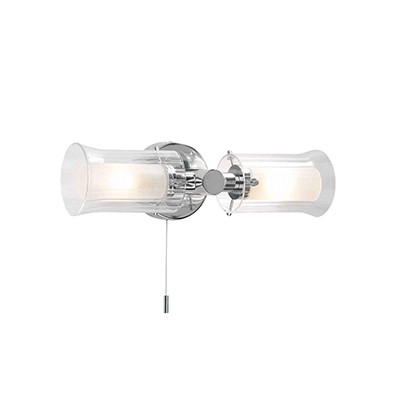
Bathroom Wall Light
The wall lights that belong in a bathroom
IP-rated wall fittings designed for bathroom zones — around mirrors, beside basins, flanking vanity units. Same styling language as interior wall lights, engineered for the conditions.
Why a bathroom-specific wall light, not an ordinary one
Standard interior wall lights are not safe or legal in a bathroom. The bathroom is divided into zones based on proximity to water, and each zone requires a minimum IP (Ingress Protection) rating. Using an unrated fitting inside a bathroom zone is a compliance failure and invalidates home insurance.
Every fitting in this range is IP-rated for bathroom use — typically IP44 for Zone 2 fittings (around the mirror and basin) and IP65 for the rare Zone 1 wall installation. For the full zone primer, see the bathroom lighting parent page.
Where bathroom wall lights earn their place
Either side of the mirror — the single most flattering lighting position in a bathroom. Two wall lights flanking a mirror at face height give even light across the face with no shadows under the eyes. Better than a single light above, better than overhead alone.
Above the mirror — a wall-mounted light or a short light bar across the top of the mirror, angled down. Works where mirror-flanking wall lights aren't practical, but less flattering than the side-light approach.
Beside vanities and dressing tables — larger bathrooms with dedicated dressing areas benefit from decorative wall lights either side of a mirror or vanity mirror.
General ambience — wall lights on side walls, away from the mirror and basin, to soften the overhead ceiling light and give the room a warm layer.
Styles in this range
Vanity strip lights — horizontal LED bars, often with multiple integrated bulbs, mounted above or beside mirrors. Clean modern look, good even output.
Globe and sconce wall lights — single-bulb wall fittings with frosted glass or opal globes. Decorative presence with diffused light.
Double wall lights — two bulbs per fitting, either vertically stacked or side-by-side. More output from a single fixing point.
Up/down wall lights — throw light both at the ceiling and the floor, creating two soft bands of light on the wall. Modern and architectural; works well in larger bathrooms with wall space to spare.
Traditional bracket wall lights — period and classical silhouettes, often with decorative shades. Suit traditional and period bathrooms.
Bulb types and smart control
Most bathroom wall lights take G9 capsule bulbs or integrated LEDs. A few take E14 candle bulbs. Check the product page for the exact cap type and bulb compatibility.
For colour temperature, 3000–4000K is the right default around a bathroom mirror — neutral enough to read as accurate skin tone. Warmer than 3000K makes skin look sallow in the mirror; cooler than 4000K reads as clinical.
Smart bulbs work in bathroom wall lights provided the cap is right, but most bathroom wall lights use integrated LEDs where the bulb isn't swappable. For full smart control, choose fittings with built-in smart functionality.
Installation
All bathroom wall lights must be installed by a qualified electrician. The job falls under Part P of building regulations and must be notifiable. Mains-voltage dimmers cannot be installed inside the bathroom zones — if the fitting is dimmable, the dimmer usually mounts outside the bathroom door.
Frequently asked questions
What IP rating do I need for bathroom wall lights?
IP44 is the minimum for Zone 2 (the 60cm area around the basin and above the bath). IP65 is required for Zone 1 (directly above or adjacent to the bath or shower) and is a safer choice for any fitting exposed to splashing or steam.
Should I put wall lights above or beside the mirror?
Beside, if possible. Two wall lights flanking the mirror at roughly face height give the most flattering, shadow-free light. A single light above the mirror casts shadows under the eyes, less helpful for shaving or makeup. If wall space doesn't allow flanking, pick a horizontal vanity strip above the mirror instead.
How high should bathroom wall lights be mounted?
Beside a mirror, roughly at face height when standing — 160–175cm from the floor. Above a mirror, just above the mirror's top edge. For ambient wall lights away from the mirror, eye-level (150–170cm) is usually right.
Are bathroom wall lights dimmable?
Many are, but dimming in a bathroom has constraints. Mains-voltage wall dimmers cannot be installed inside the bathroom zones, so the dimmer switch usually sits outside the bathroom door. Smart bulbs or smart fittings give dimming without a wall dimmer.
Can I replace a standard wall light with a bathroom-rated one?
Yes, but the wiring needs to be checked — some older bathroom wall lights were not fused in accordance with current regulations. An electrician will confirm the circuit is compliant before installing the new fitting.
Related categories
- Bathroom Lighting — IP zone primer and full bathroom range
- Bathroom Ceiling Lights — flush and semi-flush ceiling fittings
- Bathroom Spotlights — directional IP-rated downlights
- Illuminated Bathroom Mirrors — integrated mirror plus LED
- Interior Wall Lights — non-bathroom wall lights for the rest of the house