
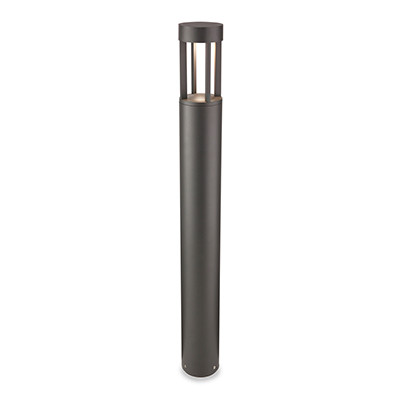
Bollard
Low-level light that marks the way
Bollards sit between 30cm and 1m tall, casting light downwards and outwards. Path edges, driveway borders, garden transitions — anywhere foot traffic needs directing after dark.
What a bollard does that other lights don't
A bollard solves a specific problem: you want to mark a path edge or boundary without lighting up the whole area. Taller fittings (post tops) light too broadly. Ground-level fittings (ground recessed) throw light only upwards. Wall lights can't reach paths away from buildings.
A bollard, at 30–100cm tall, throws light down onto the immediate surroundings — the path, the driveway edge, the border — without flooding the whole garden. The result is guided walking routes, defined boundaries, and a low-glare effect that works both functionally and atmospherically.
Where bollards earn their place
Garden and driveway paths — a series of bollards along both sides of a path defines the route and puts light exactly on the walking surface. Spacing of 2–4m between bollards gives continuous coverage.
Driveway edges — bollards along a gravel or block-paved driveway mark the edge clearly at night and help with parking alignment.
Steps and level changes — a bollard beside a step or change of level prevents missed footing. For in-step lighting, see exterior recessed lights.
Feature planting and borders — low bollards at border edges give accent light to planting without the full intensity of spike spots or floodlights.
Boundary and fence lines — along boundary walls, low fences or hedge lines where the light needs to be definitely outside, not up against a wall.
Height choices
Short (30–50cm) — low-level path edging and border accent. Throws light immediately around the bollard base. Suits narrow paths and defined garden borders.
Mid-height (50–80cm) — the most common range. Driveway marking, wider paths, primary garden routes. Tall enough to light a useful radius, short enough to feel unobtrusive during the day.
Tall (80cm–1m) — where greater light spread matters, or along driveways used by vehicles where bollards also serve as visual guidance. At this height, the line blurs with short post tops.
Lighting direction
Bollards vary in how they throw light:
Downward-throw — light exits only from the bottom face of the bollard head, illuminating the immediate surroundings without spilling upwards. Minimal glare, best for residential and unlit-neighbour-boundary applications.
Omnidirectional — light exits all around the head, illuminating a wider radius. More visible at distance; higher glare close-up.
Cut-out pattern — decorative bollards with cut-out metalwork cast patterned light on the ground around them. Design-led rather than purely functional.
Materials, IP and power
Bollards live outside year-round, often at ground level where rainwater pools and splashes hardest. IP65 is the sensible minimum; IP67 for low-level positions near standing water. Powder-coated die-cast aluminium, stainless steel and brass are the material choices for long-term durability.
Most bollards are hardwired, which means a buried cable run from the house at regulated depth. Some solar-powered bollards exist for lower-usage applications like garden borders; they're limited in winter performance and light output compared to hardwired equivalents.
Frequently asked questions
How far apart should bollards be?
2–4m spacing gives continuous path coverage for most garden and driveway installations. Closer spacing (1.5–2m) suits narrow paths or where steady light along the full length matters. Wider spacing (4–5m) is fine for driveway edge marking where the bollards serve as visual guidance rather than continuous illumination.
What's the difference between a bollard and a post top?
Bollards are shorter (typically 30cm–1m), throw light downwards onto immediate surroundings, and sit at a height below eye-level. Post tops are taller (1.2m+), often hold a lantern-style head, and cast light over a wider area. Use bollards to mark paths and edges; use post tops to light driveways and garden areas.
Do I need to hardwire bollards?
Most, yes — hardwired installation gives reliable output, no battery dependency and no winter performance drop. Solar-powered bollards exist for low-usage positions. Plug-in mains bollards can work if a weatherproof outdoor socket is available, but for a series of bollards along a path, hardwiring is much cleaner.
Can bollards have motion sensors?
Some do, though for path-lighting applications the more common control methods are dusk-till-dawn (always on at night) or timer-based (on during evening hours only). Motion sensors suit security-focused bollard installations rather than general path lighting.
Related categories
- Exterior Lighting — the full outdoor range and zone/IP primer
- Post Top Lights — taller pole-mounted alternatives
- Landscape Lighting — garden and border spike lighting
- Ground Recessed Lights — into-ground step and path alternatives
- Smart Exterior Bollards — app-controlled bollards