
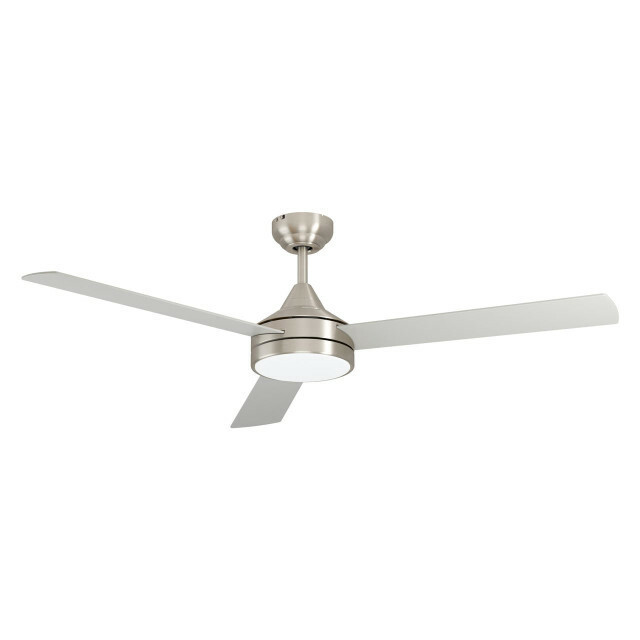
Ceiling Fans
Fans plus lights, from one ceiling fitting
Combination ceiling fans with integrated lighting. One ceiling mount-point delivering both airflow and general illumination — ideal for bedrooms, sunrooms, conservatories and warm-weather living spaces.
Why a combined fan and light fitting
In rooms where you want both ceiling lighting and air circulation, a combination fitting makes practical sense:
One ceiling position — most rooms have one central ceiling mount. A combined fitting uses that single position for both fan and light rather than needing separate fittings for each.
Unified control — both fan and light usually controlled from a single wall switch plus a remote or pull-cord, rather than two separate circuits.
Visual coherence — the fan and light are designed together to match aesthetically. Separate fittings rarely coordinate as well.
Cost efficiency — one combined fitting typically costs less than a separate fan plus separate central pendant or ceiling light.
Where ceiling fans work best
Bedrooms — where gentle air movement helps sleep temperature in warm weather. The quiet operation of modern DC-motor fans matters especially here.
Conservatories and sunrooms — south-facing glazed rooms that overheat in summer. Ceiling fans move hot air without noise or disruption.
Open-plan kitchens and living areas — large rooms where air stagnation is noticeable. A ceiling fan keeps the air moving gently.
Home offices — long working hours in warm weather. Quiet fan operation helps concentration.
Loft conversions and rooms with high ceilings — heat rises; ceiling fans can reverse direction in winter to push warm air back down into the room.
Blade count, size and airflow
Some key specifications:
Blade span (diameter) — ceiling fans are sized by the overall blade span. Typical domestic sizes are 42 inches (107cm) for smaller rooms, 52 inches (132cm) for standard living rooms, and 60 inches (152cm) plus for larger spaces. Bigger spans move more air.
Blade count — 3, 4 or 5 blades are standard. More blades usually mean quieter operation but slightly less airflow. Modern DC-motor fans with 3 or 4 blades often outperform older 5-blade AC fans in both noise and efficiency.
AC vs DC motor — AC (alternating current) motors are the older standard — cheaper but noisier and less efficient. DC (direct current) motors are newer — quieter, more energy-efficient, offer more speed steps and usually include remote control as standard. DC is the quality spec.
Airflow (CFM) — cubic feet per minute. Higher CFM means more air moved. 3,000–5,000 CFM suits most domestic rooms.
Ceiling-height considerations
Ceiling fans need specific clearance:
Minimum safe clearance — the blades must sit at least 2.1m (7ft) above the floor for head safety. 2.4m ceilings accommodate standard-drop ceiling fans comfortably.
Low-ceiling fans (flush-mount) — specifically designed to sit closer to the ceiling. Use these on 2.3m ceilings where a standard drop fan would be too low.
Sloped ceilings — need a specific angle-compatible mount. Not all ceiling fans are sloped-ceiling compatible; check the product page if your ceiling isn't flat.
Switching and control
Most ceiling fans offer multiple control methods:
Wall switch — basic on/off, sometimes also with speed stepping.
Pull cords — one cord for the fan, one for the light. Simple but requires reaching to the ceiling.
Remote control — handheld remote for speed, direction, light on/off and dimming. Standard on most modern fans.
Smart app control — some newer ceiling fans integrate with Alexa, Google Home or dedicated apps for voice and scheduled control.
Installation
Ceiling fans require specific installation considerations:
Weight and balance — ceiling fans can weigh 5–15kg and produce vibration. Installation needs a properly-rated ceiling mount (fan-rated junction box), not a standard plasterboard rose.
Electrical — Part P-notifiable. Must be done by a qualified electrician.
Balancing — new fans may need balancing after install if any wobble is noticeable. Balance kits are usually included.
Frequently asked questions
Are ceiling fans noisy?
Modern DC-motor fans are very quiet — quieter than most domestic refrigerators at low speeds. Older AC-motor fans can be noticeably noisier. If quiet operation matters (bedroom use especially), pay the premium for a DC-motor fan.
Can I use a ceiling fan in winter?
Yes — most ceiling fans have a reverse-direction setting that pushes warm air from the ceiling back down into the room. Useful in rooms with high ceilings where heat stratifies.
Do ceiling fans save on air conditioning?
Ceiling fans don't cool the air, but they make rooms feel cooler by circulating air across skin. In warm climates, running a ceiling fan alongside air conditioning lets you set the AC thermostat a few degrees higher for the same perceived temperature, saving energy.
Can I install a ceiling fan myself?
Part P regulations mean electrical installation should be done by a qualified electrician. The ceiling mount must also be fan-rated (stronger than a standard pendant rose) which often needs additional bracing — usually an electrician or builder task.
Related categories
- Ceiling Lights — standalone ceiling lighting
- Furniture & Homewares — the full furniture range
- Smart Lighting — smart-compatible ceiling fans
There are no products listed under this category.