Ceiling
The workhorse of the room
Ceiling lights do the job no other fitting can: even, general light across the whole space. Pick the right one and you barely notice it. Pick the wrong one and you can't look anywhere else.
Flush, semi-flush or pendant — how to choose
Three broad formats cover almost every ceiling light. Which one you pick depends mostly on ceiling height and style.
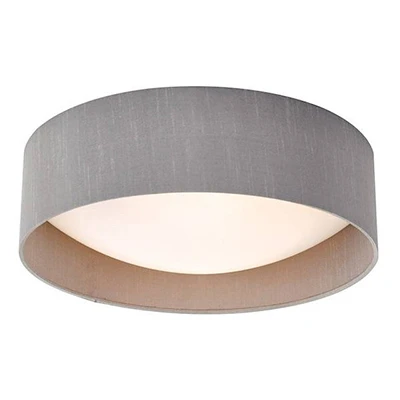
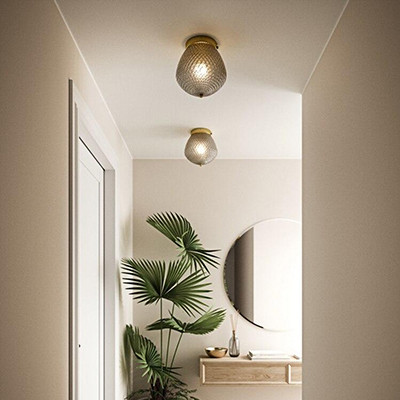
Flush ceiling lights sit tight against the ceiling with no drop at all. Built for low ceilings, hallways, bathrooms and anywhere you can't afford to lose vertical space. Usually a disc-shaped diffuser or a shallow bowl. See our flush ceiling range.
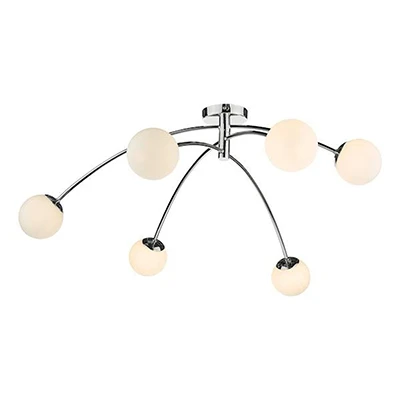
Semi-flush ceiling lights sit just below the ceiling with a short drop — typically 10–25cm. Gives the decorative presence of a pendant without eating the same amount of headroom. The default choice for standard 2.4m ceilings in most rooms. Browse semi-flush ceiling.
Pendant lights hang further below the ceiling on a cord or rod. Right for 2.6m+ ceilings and anywhere the ceiling light is doing visual work as well as lighting the room — dining tables, kitchen islands, stairwells. The full pendant range covers this.
Sizing the fitting to the room
A rough sizing rule that works well: add the room's length and width in metres, then use that number in inches as a guide for the fitting's diameter. A 4m x 5m living room suits a ceiling light around 22–25cm in diameter. A bathroom or small hallway may only need 15–20cm.
Don't over-light. A too-bright ceiling light flattens the room; a correctly sized fitting leaves room for table lamps, floor lamps and wall lights to do their job. For rooms where the ceiling light is the only source, aim higher on lumens — 1500–2000 total. For rooms with other lighting layers, 800–1200 is usually enough.
Ceiling height guidance
Under 2.4m ceilings — flush only, or very short-drop semi-flush. A pendant will feel oppressive.
2.4m–2.6m ceilings — flush or semi-flush. Pendants only if the drop is short and the fitting is small.
2.6m–3m ceilings — any format. Semi-flush and pendants both look balanced. This is the sweet spot for most decorative ceiling lights.
3m+ ceilings — pendants and chandeliers start to shine. Flush lights will look lost at this height.
Bulbs, dimming and colour temperature
Most ceiling lights take E27 or E14 caps; a growing number use integrated LEDs that give 25,000+ hours of service and can't be swapped. Integrated-LED fittings are usually slimmer and more modern, with colour-changing or tuneable-white options on the smart range.
Warm white (2700K) is the default for living rooms, bedrooms and hallways. Cool white (3000–4000K) works better in kitchens, bathrooms and workspaces where you want a sharper, more functional feel. Check the product page for colour temperature and whether the fitting is dimmable.
For app-controlled ceiling lights with tuneable white, scheduling and smart-home integration, see our smart ceiling lights range.
Low-ceiling solutions
If the room has a ceiling under 2.4m — common in bedrooms, bathrooms and hallways — stick to flush fittings or very shallow semi-flush. A deep fitting on a low ceiling feels like walking into a cave. Our flush ceiling range is filtered specifically for this.
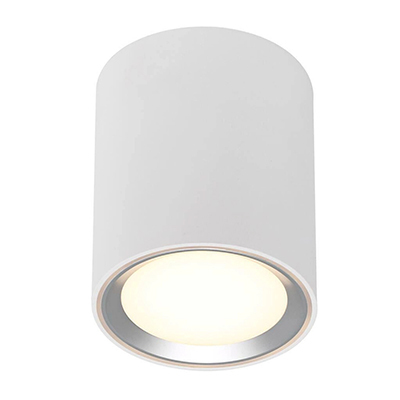
Another option for low ceilings is a set of surface downlights — small, shallow, directional lights that spread across the ceiling rather than centring on one spot. Good for kitchens, utility rooms and hallways where even coverage matters more than a decorative centrepiece.
Frequently asked questions
What's the difference between flush and semi-flush?
A flush ceiling light sits directly against the ceiling with no drop — its bottom surface is the ceiling. A semi-flush sits slightly below the ceiling, usually 10–25cm, on a short stem or chain. Semi-flush gives decorative presence; flush saves headroom.
How big should my ceiling light be?
Add the room's length and width in metres — the total in inches is a rough guide for the fitting diameter. Cross-check against ceiling height: low ceilings suit smaller, shallower fittings; high ceilings carry larger pendants and chandeliers comfortably.
Can I install a ceiling light myself?
Replacing an existing ceiling light like-for-like is DIY territory with the power off at the consumer unit. Installing a new fitting where there wasn't one, or moving from a single to a multi-point installation, should be done by a qualified electrician.
Are ceiling lights dimmable?
Many are, but it depends on the bulbs and the dimmer. Replaceable-bulb fittings (E27, E14, G9) become dimmable with a dimmable LED bulb and a trailing-edge LED dimmer switch. Integrated-LED fittings are dimmable only if the product page says so — check before ordering.
What bulb does a ceiling light take?
Most take E27 (standard screw) or E14 (small screw) caps. Modern slim designs often have integrated LEDs that can't be replaced. Bathroom ceiling lights sometimes use GU10 spotlight bulbs or G9 capsules. Check the product page for the exact cap type and maximum wattage.
Can ceiling lights go in a bathroom?
Only if they're IP-rated appropriately. Bathroom ceilings fall into zone 1 (above the shower/bath) and zone 2 (adjacent to), both of which require minimum IP ratings. Use our bathroom ceiling range where every fitting is IP-rated for bathroom use.
Related categories
- Flush Ceiling Lights — close-to-ceiling fittings for low-ceiling rooms
- Semi-Flush Ceiling Lights — short-drop fittings, the default for standard ceilings
- Pendant Lights — longer-drop ceiling lights, for higher ceilings and statement spaces
- Chandeliers — when the ceiling light is also the room's focal point
- Bathroom Ceiling Lights — IP-rated ceiling fittings safe for bathroom zones
- Smart Ceiling Lights — app-controlled ceiling lights with tuneable white