
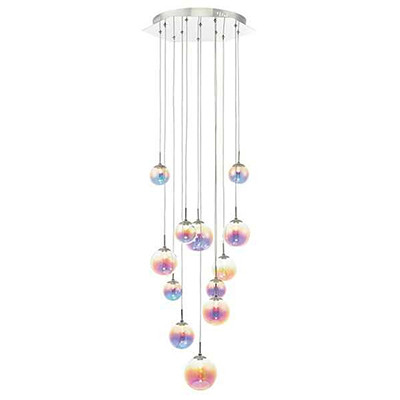
Cluster Pendants
One rose, multiple lights, sculptural drop
Cluster pendants drop three or more shades from a single ceiling rose at different lengths. Sculptural, dramatic, and the single best way to turn a high-ceilinged room into a statement.
Where cluster pendants work best
A cluster pendant packs multiple lights into a single-rose installation. Three, five, seven or more shades drop from one mounting point at varying lengths — creating a sculptural arrangement that moves the eye vertically and fills the space a single pendant would leave flat.
The places they earn their keep:
Stairwells and double-height hallways — the ceiling is high, the space is tall, and a single pendant would get lost. A long-drop cluster fills the vertical space and makes the stairwell a feature rather than a pass-through.
Living rooms with high ceilings — 2.8m+ ceilings swallow a single pendant. A mid-drop cluster gives the room visual anchor without requiring the install of a full chandelier.
Dining rooms — clusters over a dining table give each diner their own small pool of light, rather than a single pendant casting shadow across the table.
Entrance halls and reception areas — first-impression spaces where a cluster sets the tone for the rest of the house.
Cluster vs single vs bar — picking between them
Use a single pendant when the space is small, the ceiling is low, or the design calls for minimalism.
Use a bar pendant when the surface below is long and narrow — kitchen islands, long tables. Even light along a length.
Use a cluster when the space is tall, the ceiling is high, or you want a sculptural vertical composition. Best over round or square dining tables, in stairwells, and in tall living rooms.
Drop length and staggering
The point of a cluster is the vertical composition. Shades should drop at clearly different lengths — not by a few centimetres, but by 20cm or more between each. Most clusters ship pre-set with graduated drops; many allow you to adjust each individual cord at install.
For a stairwell, drop the lowest shade to around head height at the top landing, with higher shades staggered upwards. For a dining table, keep the lowest shade 75–90cm above the tabletop, with higher shades visible but not hanging into the sightline across the table.
Bulbs and style
Most cluster pendants take multiple E27 or E14 bulbs. LED filament bulbs suit cluster designs especially well — the exposed filament becomes part of the decorative look, not just a light source. Warm white (2700K) is the right default for almost every cluster application.
Shade styles across the cluster range cover glass globes, fabric drums, metal cages, industrial pendants, and shade-less exposed-bulb designs. The cluster form suits sculptural shades that work as a collection — not ornate shades that compete for attention.
Installation
Cluster pendants are heavier and more complex than single pendants — multiple cables feed through the canopy, each shade has its own cord, and the whole fitting hangs from a single mounting point. Installation should be done by an electrician, who will also confirm the ceiling fixing can support the weight.
Frequently asked questions
How many lights should a cluster pendant have?
Three is the minimum that reads as a cluster; five to seven is the sweet spot for most rooms; nine or more suits double-height stairwells and very large rooms. An odd number usually composes better than an even number.
Can a cluster pendant hang in a low-ceiling room?
Usually not. The point of a cluster is the vertical composition, which needs at least 2.6m of ceiling to work. Under 2.4m, shades hang low enough to feel oppressive. For low ceilings, a single pendant or semi-flush fitting works better.
Do all the lights in a cluster switch on together?
Yes — a cluster pendant is a single circuit, all bulbs on one switch. For dimming, pair with a dimmable LED and a trailing-edge dimmer. For individual control of bulbs, that would require each bulb on its own circuit, which isn't practical within a cluster design.
Can I adjust the individual drops?
Most cluster pendants allow individual cord adjustment at install, within the maximum length the cord provides. Worth planning the staggered drops before the electrician visits, so adjustment is a one-off job rather than repeated trips up the ladder.
Related categories
- Pendant Lights — the full pendant range
- Bar Pendants — horizontal multi-light alternative
- Single Light Pendants — single-pendant alternative
- Feature Pendants — large statement pendants, an alternative for dramatic rooms
- Chandeliers — when the cluster needs to become a full chandelier