
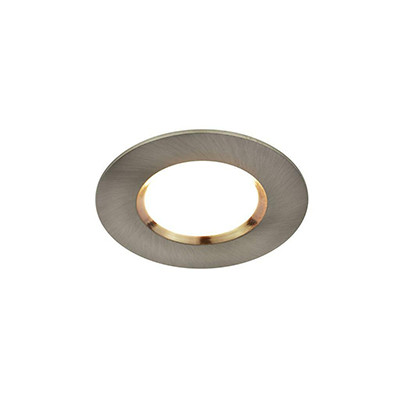
Exterior Recessed
Light built into the structure itself
Wall-recessed step lights, soffit downlights and recessed fittings for stairs, walkways and architectural walls. Clean-lined lighting that disappears into the build.
Where exterior recessed lighting works
Recessed exterior lighting mounts inside the wall, step or soffit rather than projecting from it. The fitting itself barely shows — often just a trim face flush with the surface — leaving the light effect as the only visible thing. Clean, architectural, and surprisingly versatile.
The main applications:
Step lights — recessed into the risers of outdoor stairs, casting light down onto each tread. The single most practical use of recessed exterior lighting. Makes steps safe at night without a separate post or wall fitting.
Wall-face recessed — set into external walls at around head height or lower, throwing a soft wash of light up or down the wall. Used for driveways, garden boundary walls and architectural accent.
Soffit-recessed downlights — set into the underside of soffits, porch ceilings and overhangs, throwing light downwards onto the building face or the ground below. Arguably the cleanest way to light a facade.
Decking and pathway recessed — for recessed-into-ground applications, see ground recessed lights. This category covers the wall and vertical surfaces.
Step lights — the most common use
Outdoor steps are the single biggest safety-related use of recessed exterior lighting. One small recessed light per step riser, angled to wash light across the tread, makes every step visible at night without flooding the surrounding area. Particularly valuable for garden steps, basement entrances and terrace access where the steps aren't visible from the house.
Spacing and sizing: one fitting per riser for continuous coverage, one per two risers for accent-only. Fittings are typically 60–100mm in diameter, with an installation depth of 50–80mm — the step construction needs to accommodate the back box.
IP ratings and installation depth
Recessed exterior fittings must handle direct weather exposure, often at low level where water pools and splashes. IP65 is the sensible minimum; IP67 for ground-adjacent or ground-level positions.
Installation depth matters. A recessed fitting needs depth behind the face surface for the housing, driver and cable entry. Most step lights need 50–80mm depth; some wall-face fittings need up to 100mm. This has to be planned into the build, particularly in masonry walls or concrete steps — retrofitting recessed lighting into finished masonry is expensive and messy.
Materials
Exterior recessed fittings favour stainless steel, powder-coated aluminium and solid brass. Marine-grade 316 stainless steel is the most durable for coastal and high-exposure applications. Plastic trim faces exist at lower price points but are less durable and more prone to UV degradation over time.
LED and colour temperature
Almost all exterior recessed lighting uses integrated LEDs — sealed, slim, long-life. Replaceable-bulb versions are uncommon; the sealed form is part of the appeal and the IP-rating.
2700–3000K warm white is the architectural-accent default. Cooler 4000K+ reads as security lighting and is usually reserved for functional step and pathway applications where you want high visibility.
Frequently asked questions
Can I retrofit recessed step lights into existing steps?
Difficult. The step riser needs a cutout and back-box cavity, plus cable routing to the power supply — all challenging in finished masonry or concrete. Much better to plan recessed lighting before the steps are built or at the time of a step reconstruction.
What IP rating do step lights need?
IP65 minimum for most outdoor step applications; IP67 for steps that get direct rain and standing water. Ground-level recessed fittings (paths, driveways) need IP67 and should be walk-over rated — see ground recessed lights for those.
Can I replace the LED in a recessed fitting?
Usually no — the LED is integrated and the fitting is sealed for its IP-rating. When the LED eventually fails (25,000+ hours at normal use), the fitting is replaced. This is the trade-off for the slim, sealed form.
Are recessed fittings bright enough for security use?
Wall-face recessed fittings can serve a security role as part of a layered scheme. For primary security lighting — driveways, back gardens, entry points — use floodlights or exterior spotlights, which deliver higher output and often include PIR motion sensors.
Related categories
- Exterior Lighting — the full outdoor range and zone/IP primer
- Ground Recessed Lights — walk-over in-ground fittings
- Exterior Wall Lights — surface-mounted wall alternatives
- Exterior Spotlights — directional beam alternatives
- Landscape Lighting — garden-feature accent lighting