
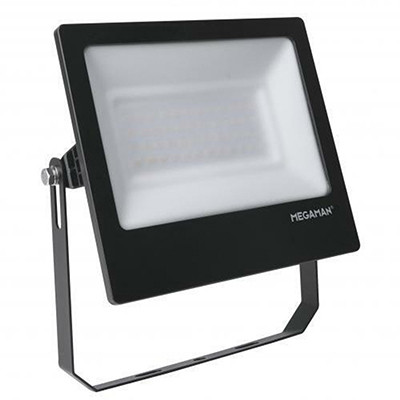
Floodlight
Bright, wide-beam outdoor light for coverage and security
Floodlights throw broad, high-output light across driveways, back gardens and exposed entry points. Wider than spotlights, brighter than wall lights — the right choice when security and large-area coverage matter.
What a floodlight is for
Floodlights solve one problem: lighting a large outdoor area to high intensity, fast. Wide beam angles (usually 90–120°), high lumen output and mains power make them the right fitting when the job is security, coverage or visibility rather than atmosphere.
The places they actually earn their keep:
Driveways and parking areas — one or two floodlights on the front of the house or on a garage, delivering even bright light across the parking zone. Valuable for arriving home after dark and for security.
Back gardens — wall-mounted floodlights on the rear of the house illuminate the whole garden for security and occasional outdoor use. Usually PIR motion-sensor activated.
Side passages and service access — narrow side returns and service access ways where you need visibility for bin runs, deliveries and security. PIR is almost always the right trigger here.
Commercial and warehouse applications — car parks, loading bays, perimeter fencing. Higher-output floodlights rated for commercial wiring and longer duty cycles.
Floodlight vs spotlight vs wall light
Three different formats for three different jobs.
Wall lights provide ambient welcoming light at normal building scale. Not bright enough for security or large-area coverage.
Spotlights have a narrow beam aimed at a specific target — a feature, a tree, a piece of signage. Focused and directional.
Floodlights have a wide beam covering a large area with high output. Not directional at a specific target, just broadly bright across a space.
Mixing floodlights and spotlights in the same exterior scheme is common and effective — floodlights for coverage, spots for feature accent, wall lights for ambient welcome.
PIR motion sensors and dusk-till-dawn
Most residential floodlights include a PIR (Passive Infrared) motion sensor. The light stays dark until movement is detected, then illuminates for a configurable duration (usually 30 seconds to 10 minutes) before switching off. This is the right default for security-focused floodlights — full-time illumination is wasteful and irritates neighbours.
Key PIR specs to check:
Detection range — typically 8–15m for residential floodlights. Pick based on the size of the area being covered.
Detection angle — 110–180° horizontal coverage. Wider angles cover larger areas; narrower angles reduce false triggers from passing traffic.
Adjustability — most PIR sensors let you adjust sensitivity, light duration and ambient-light threshold (so it doesn't trigger during daylight).
Dusk-till-dawn floodlights (permanent on during darkness) exist but are mainly for commercial applications where continuous coverage is required. For residential use, PIR is almost always the right choice.
Output, beam and colour
Lumens — residential floodlights typically range from 1500lm to 5000lm. 2000–3000lm covers a domestic driveway or back garden comfortably; 5000lm+ is needed only for larger areas or commercial applications.
Beam angle — 90–120° is standard for domestic floodlights. Wider beams give better area coverage; narrower beams concentrate light on a specific space.
Colour temperature — 4000K cool white is the default for security floodlights — crisp, high-contrast, reads as functional rather than decorative. 5000K+ daylight is sometimes used for commercial applications. Warm white (2700K) is rare in floodlighting; it reads as cosy but undersells the security function.
Installation and IP
Floodlights hardwire into the mains via an outdoor junction box, Part P-notifiable. IP65 is the residential standard; commercial floodlights often rate IP66 or higher. Installation is always an electrician's job.
Frequently asked questions
How bright should my floodlight be?
2000–3000 lumens for a domestic driveway or back garden. Below 1500lm, the floodlight reads as too dim for security use. Above 5000lm, it becomes uncomfortably bright for residential contexts and is likely to irritate neighbours.
Do floodlights need motion sensors?
Not strictly, but for residential use a PIR motion sensor is almost always the right choice. Permanent-on floodlights are wasteful, glare into windows, and cause neighbour complaints. PIR-activated floodlights illuminate only when needed, cut energy use and reduce disturbance.
Can I add a motion sensor to an existing floodlight?
Some floodlights have built-in PIR; others can accept a separate PIR sensor wired into the same circuit. If retrofitting, an electrician will confirm the sensor is compatible with the floodlight's load rating before installation.
Will my floodlight annoy my neighbours?
It can, especially if it's over-bright, permanently on, or aimed into neighbouring windows. Use PIR sensors to keep the light off unless needed, aim the floodlight away from neighbouring properties, and stick to 2000–3000lm for residential applications. "Neighbourhood-friendly" floodlighting is always better than maximum-output brightness.
Related categories
- Exterior Lighting — the full outdoor range and zone/IP primer
- Exterior Spotlights — narrower beam directional alternatives
- Exterior Wall Lights — lower-output ambient wall alternatives
- Smart Exterior Wall Lights — app-controlled and scheduled alternatives