
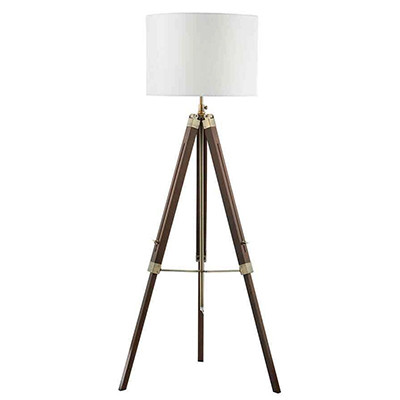
Floor Lamp
Add a light without touching the wiring
The easiest way to fix a dim corner or build a reading nook: a floor lamp. No electrician, no rewire, just plug it in and light lands exactly where you want it.
When a floor lamp is the right answer
A floor lamp solves three problems in one piece: it adds light where there's no ceiling fixture, it brings the brightness down to seating height, and it does both without any wiring work. For rented homes, listed properties or anywhere a ceiling light can't go, a floor lamp is often the most useful fitting in the room.
They also fix dark corners in properly lit rooms. A single ceiling light always leaves shadows in the corners; a floor lamp next to a reading chair, beside a sofa or behind a console table fills the gap with warm, directional light exactly where people actually sit.
Styles and where each works
Tripod floor lamps — three-legged base, tall shade, classic silhouette. The most versatile style, works in living rooms, bedrooms and corners alike. Usually takes a standard drum or empire shade.
Arc floor lamps — a long curved arm that reaches over furniture. Ideal for throwing light onto a sofa or coffee table from a floor-mounted base a metre or more away. Strong statement piece in open-plan living rooms.
Reader / task floor lamps — adjustable arm and directional head, often with a smaller shade. Built for reading chairs, home offices and hobby spaces where you need focused task light rather than ambient glow. Usually features a pivoting arm and a touch or inline dimmer.
Multi-arm floor lamps — two or more heads on a single stem, each independently adjustable. Works as a single fitting covering multiple tasks: one head angled over the sofa, another at a side table.
Tower and column lamps — tall, slim, often integrated LED. Architectural and modern, suits minimalist rooms and corridors where a traditional tripod would look busy.
Sizing and placement
Most floor lamps stand 150–180cm tall. The key sizing rule: when seated next to the lamp, the bottom of the shade should be roughly at eye level. Too tall and the bulb glares; too short and the lamp throws most of its light at the sofa back, not where you're sitting.
For a reading corner, position the lamp just behind and to the side of the chair — shade bottom at eye level, bulb hidden from direct view. For ambient corner fill, a taller floor lamp placed in the corner of the room throws light out into the space and up onto the wall.
Switches, dimmers and smart control
Most floor lamps have a foot switch on the cord or an inline switch a short way up the cord from the plug. Some modern designs use a touch-sensitive stem or a dial dimmer — handy for gradually adjusting brightness without getting up.
Smart bulbs in E14 and E27 fit straight into most floor lamps, giving app, voice and schedule control. For floor lamps with integrated LEDs, the LED isn't swappable — choose from our smart floor lamp range if you want app control on an integrated-LED fitting.
Bulbs and brightness
Most floor lamps take E27 caps, sometimes two or three bulbs in a multi-arm design. For a primary corner lamp, aim for 800–1000 lumens per bulb (roughly equivalent to a 60–75W incandescent in LED). For a reader, 600–800 lumens with a warm 2700K colour is the right default.
Almost every floor lamp in this range is dimmable when paired with a dimmable LED bulb and either an inline dimmer or a dimmable smart bulb.
Frequently asked questions
Do I need an electrician to install a floor lamp?
No. Every floor lamp in this range plugs straight into a standard 13A socket. That's one of the main reasons floor lamps exist — no wiring, no chasing cables, no regulatory sign-off.
What height should a floor lamp be?
Most sit at 150–180cm. The important measurement is the shade height when you're sitting next to it — the bottom of the shade should be roughly at eye level when seated. This keeps the bulb hidden and puts the light at the right height for reading.
What bulb does a floor lamp take?
Most take E27 (standard screw) or occasionally E14 (small screw) bulbs, with some modern and arc designs using integrated LEDs that can't be replaced. Check the product page for cap type, bulb count and maximum wattage.
Are floor lamps dimmable?
Most are, either via an inline cord dimmer, a touch stem, or simply by using a dimmable LED bulb on a lamp with an on/off switch. Floor lamps with integrated LEDs vary — check the product page for "dimmable" before ordering.
Can I use a smart bulb in a floor lamp?
Yes, as long as the cap matches (usually E27) and the shade has enough internal clearance. For floor lamps with integrated LEDs you can't swap the bulb, so choose a smart-compatible fitting from our smart floor lamp range instead.
Which floor lamp is best for reading?
A dedicated reader with an adjustable arm and a smaller directional shade, positioned just behind and to the side of the reading chair. Look for 600–800 lumens with a warm 2700K LED bulb, and ideally an inline dimmer so you can drop the brightness for evening reading.
Related categories
- Table Lamps — shorter lamps for side tables and bedsides, pair with a floor lamp for a layered scheme
- Shade Only — replacement shades for floor lamp heads
- Tiffany Floor Lamps — stained-glass floor lamps with decorative amber-toned light
- Smart Floor Lamps — app-controlled floor lamps with dimming and scheduling
- Exterior Floor Lamps — weatherproof floor lamps for covered outdoor spaces