
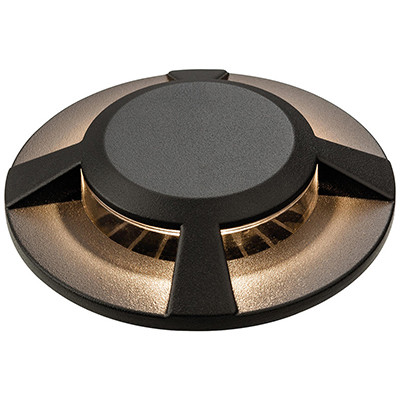
Ground Recessed Light
Lights you can walk on
Ground-recessed lights set flush into paths, driveways, decks and stone surfaces. Walk-over rated, IP67+, engineered to disappear during the day and light up a pathway, wall or feature at night.
What ground-recessed lights are for
Ground recessed fittings sit flush with the surface — in a driveway, path, decking, patio, even inside a lawn — throwing light upwards while remaining invisible during the day. Walk-over rated for foot traffic, drive-over rated for vehicle traffic, sealed against rainwater and ground moisture.
The key applications:
Facade uplighting — recessed into the ground at the base of an external wall, throwing light up the facade to accent architectural features at night.
Path edge marking — set into the path surface itself or immediately beside it, lining a walking route with flush light. Minimal visual clutter during the day.
Driveway markers — drive-over rated fittings set into the driveway surface or edge, marking the entrance and parking zones.
Tree uplighting from the ground — set into the ground at the base of a tree, throwing light up into the canopy without a visible above-ground fitting.
Decking recessed — small LED fittings set into decking surfaces or riser faces, creating lit edges and step definition.
Garden boundary accent — set along lawn-to-path transitions or border edges, defining the boundary without a visible fitting.
Walk-over vs drive-over ratings
Ground-recessed fittings are rated for the weight they can handle:
Walk-over rated — supports pedestrian traffic. Suitable for paths, patios, decking, lawns and any position where only foot traffic is expected. Typical load rating 300–500kg.
Drive-over rated — supports vehicle traffic. Suitable for driveways, parking areas and shared drive-and-path surfaces. Typical load rating 2,000–5,000kg.
Use the wrong rating and the fitting will crack under load. Always confirm the rating matches the intended traffic before purchase.
IP ratings for ground positions
Ground-level fittings face the worst of weather — standing water, direct rain, frost, temperature cycling, soil moisture. IP67 is the minimum standard for ground-recessed lighting. IP68 (submersible) is required for fittings in areas that regularly flood or in water features.
The sealing is in the fitting housing, not added after install. Never use a fitting rated below IP67 in a ground-recessed position, regardless of how "sheltered" it looks during the day — rainwater will pool in the recess and destroy anything less-rated within months.
Beam angles and applications
Narrow beam (10–24°) — for facade uplighting and feature tree uplighting, where a concentrated beam gives a strong architectural effect.
Medium beam (36–45°) — for path marking and general accent lighting, where a wider spread of soft light suits the job.
Asymmetric / wall-wash — purpose-designed for facade uplighting with a forward-throwing beam rather than straight-up. Gives more even wall coverage.
Most ground recessed lights use integrated LEDs; replaceable GU10 versions exist but are less common given the sealing requirements.
Installation
Ground-recessed fittings need a back-box cavity set into the ground or surface during construction, plus cable routing from the supply to the fitting location. Retrofitting into finished paving, tarmac or concrete is expensive and messy — much better to plan the fittings before surface work.
Installation is always an electrician's job, Part P notifiable. Cable runs to ground-level fittings often route through underground ducting; your electrician or groundworker will confirm the right approach for the specific install.
Frequently asked questions
What IP rating do I need for ground-recessed lights?
IP67 minimum. IP68 (fully submersible) for fittings in wet zones, pond edges, or any area that regularly floods. Never use a lower-IP fitting in a ground position — rainwater will collect in the recess and destroy it.
Can I retrofit recessed lights into my existing driveway?
Possible but expensive. Each fitting needs a core-drilled recess plus underground cable routing. Much better to plan ground-recessed lighting during new-build, resurfacing or landscaping work rather than cutting into a finished surface.
Are ground recessed lights drive-over rated?
Only some are. Driveways and car-accessible surfaces need drive-over rated fittings (typically 2,000kg+ load rating). Walk-over rated fittings are for pedestrian-only surfaces and will crack under vehicle weight. Check the product page before ordering for a driveway.
How hot do ground recessed lights get?
Modern LED ground lights run warm to the touch but not hot — typically 40–60°C on the lens face during operation. Unlikely to damage surrounding paving or grass. Older halogen ground fittings ran much hotter and could damage adjacent planting; those are largely phased out.
Related categories
- Exterior Lighting — the full outdoor range and zone/IP primer
- Exterior Recessed — wall-recessed step and soffit fittings
- Landscape Lighting — above-ground spike alternatives
- Exterior Spotlights — above-ground spotlight alternatives
- Bollards — low-level above-ground path lighting