
Landscape Lighting
Light for the garden, not the building
Spike spots, border lights and plant-focused outdoor fittings. Landscape lighting is decorative and atmospheric — for feature planting, garden focal points and borders — rather than functional security or path marking.
What makes lighting "landscape"
Landscape lighting is the decorative, garden-feature end of outdoor lighting. The point isn't security, path marking or general illumination — it's atmosphere. The best landscape lighting is barely noticed as a fitting; you see the effect on the planting, the wall, or the garden feature, not the fixture itself.
Typical applications:
Uplighting trees and shrubs — a spike spot at the base of a tree, aimed up into the canopy. The tree becomes a nighttime sculpture, especially effective for mature specimen trees, topiary and architectural plants.
Border and planting accent — low-level spike or stake lights along a border, casting soft light upwards onto the planting. Works especially well in Mediterranean, rockery and architectural planting schemes.
Wall and facade washing — spike spots set back from a wall and aimed at it, creating a soft wash of light up the vertical surface. Great for boundary walls, trellises and textured brick.
Statue and feature lighting — a single spot aimed at a garden statue, urn, sundial or water feature turns it into a nighttime focal point.
Pond and water feature edges — low-level spike or bollard-like fittings around a pond edge, highlighting the water surface at night.
Spike vs stake vs spread
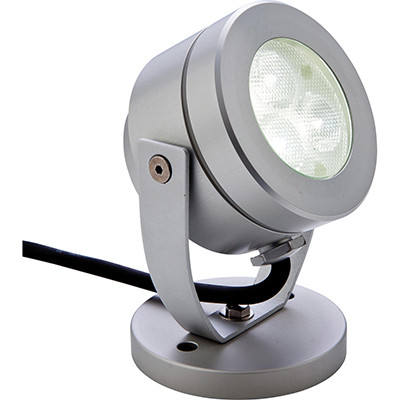
Spike spots — the classic landscape fitting. A spotlight head on a spike that pushes into soft ground. Adjustable angle for aiming at trees, walls or features. The most versatile landscape format.
Stake lights — similar concept to spike but usually with a lantern-style head rather than a directional spot. Decorative presence during the day as well as a light source at night. Good for border edges and pathways.
Spread lights — stake-mounted fittings with a "hat" that directs light downwards and outwards in a pool. Ideal for illuminating low planting and ground cover without the glare of an upward spot.
Voltage — mains, 12V and solar
Mains-voltage (240V) — full-brightness, reliable, hardwired landscape fittings. Electrician install required. The right choice for permanent, feature-led landscape lighting.
Low-voltage (12V) — a transformer near the house steps the voltage down, with cable runs to the individual fittings. Easier to install (lower-spec cable, less stringent burial requirements, sometimes DIY-friendly), and safer around planting where accidental cable damage is more likely. Very popular for landscape-specific installations.
Solar-powered — built-in solar cells and batteries. Best used as supplementary accent lighting; primary landscape effect needs mains or 12V for reliable year-round performance.
Materials and IP
Landscape fittings sit at ground level in direct contact with soil, rain and occasional frost. IP65 minimum; IP67 for spike spots pushed into damp ground. Powder-coated die-cast aluminium, stainless steel and brass handle landscape conditions well. Solid brass develops an attractive weathered patina over time.
Colour temperature
2700–3000K warm white is the landscape-lighting default. Warmer light makes foliage read greener and bark read richer; cooler light can make planting look washed-out and grey. Reserve 4000K+ for architectural wall-washing where crisp definition matters more than warmth.
Frequently asked questions
Is low-voltage (12V) landscape lighting easier to install myself?
Yes, within limits. 12V systems are less regulated than mains-voltage and can be DIY-installed in many cases — a transformer plugs into an outdoor socket, with simple two-core cable running to each fitting. The transformer connection itself may still be notifiable depending on installation details. Check with an electrician if in doubt.
How many landscape lights do I need for my garden?
Depends on what you're lighting. One spot per feature tree or statue; two or three spread lights along a 5m border; four or five spike spots to wash a 10m boundary wall. Layer rather than flood — landscape lighting works best when it picks out individual features rather than lighting the whole garden uniformly.
Will landscape lights damage my planting?
No, at the output levels used for decorative landscape lighting. LED landscape fittings produce very little heat and the light levels are far below those that affect plant growth. The cable runs are the bigger concern — keep cables away from areas you regularly dig, or bury deeper than the usual garden fork depth.
Can I mix landscape lighting with security lighting?
Yes, and often successfully. Landscape lighting covers atmosphere and feature accent; floodlights or exterior spotlights with motion sensors cover security. The two serve different purposes and sit comfortably alongside each other.
Related categories
- Exterior Lighting — the full outdoor range and zone/IP primer
- Exterior Spotlights — higher-output directional alternatives
- Bollards — higher-level path and boundary lighting
- Ground Recessed Lights — walk-over in-ground alternatives
- Portable Lighting — seasonal and temporary garden lighting