
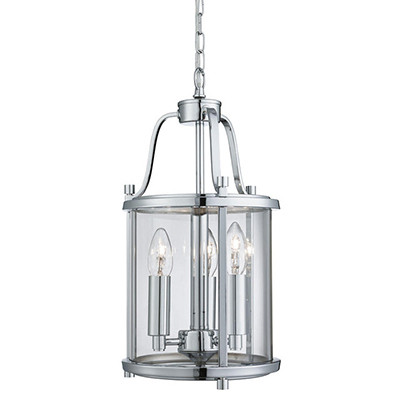
Lantern
Decorative enclosed-glass lighting
Indoor lanterns bring the silhouette of traditional outdoor lighting inside — glass-panelled enclosures, ornate metalwork, warm enclosed light. For hallways, entrance halls and period interiors.
What makes a fitting a "lantern"
A lantern is a lighting fitting built around an enclosed glass or crystal chamber — typically four to six sides of glass panels set into a metal frame, with a bulb mounted centrally inside. The effect is a soft, contained glow rather than an open beam.
Lanterns originated as practical outdoor fittings — carried, hung or mounted, with the enclosed glass protecting the flame or bulb from wind and rain. Indoor lanterns borrow that silhouette for decorative effect. The enclosed form gives a lantern visual weight and period presence that open-fitting pendants and ceiling lights lack.
Where an indoor lantern is the right choice
Entrance halls and porches (indoor) — a lantern-style pendant in an entrance hall sets a traditional or transitional tone from the moment someone walks in. Works particularly well in period properties with high ceilings.
Hallways with character — a series of small lanterns along a hallway gives period elegance that standard ceiling lights can't match.
Traditional dining rooms — a single large lantern over a dining table gives the enclosed, contained light of candlelight with the reliability of a modern fitting.
Cottage and country-style kitchens — lanterns suit rustic and traditional kitchens better than sleek modern pendants.
Period and Victorian interiors — buildings where the architecture calls for fittings that match the era. Lanterns are the most period-appropriate ceiling-light format.
Mounting formats
Pendant lanterns — hanging lanterns dropped from the ceiling on a chain or cord. The most common format. Drops of 40–80cm for standard ceilings; 1m+ for taller entrance halls and period properties.
Semi-flush lanterns — lantern shade on a short drop (10–25cm). For lower ceilings where a full pendant lantern would crowd the space.
Flush lanterns — shallow lantern-style fittings mounted tight to the ceiling. The right choice for rooms under 2.4m where even a short drop would feel too heavy.
Wall-mounted lanterns — lantern-style wall lights for hallways and entrance areas. See the wall light range.
Styles
Traditional glass-and-brass — classic four-sided or six-sided glass lantern in brass, bronze or aged metal. The period silhouette. Suits Victorian, Georgian and Edwardian properties.
Coaching-style — taller, narrower lanterns with curved glass panels. Often in black or aged finishes. Suits country houses, stable conversions and rustic interiors.
Industrial lantern — metal-framed lanterns with heavier construction, often in black or weathered finishes. Works in warehouse-style and loft interiors.
Modern lantern — clean-line geometric lanterns that reference the traditional silhouette without committing to period styling. Suits transitional interiors that mix old and new.
Bulbs and colour
Most indoor lanterns take a single E27 or E14 bulb; some larger lanterns take multiple E14 candle bulbs arranged inside the chamber. LED filament bulbs work especially well in lanterns — the visible filament becomes part of the decorative composition, visible through the glass panels.
Warm white (2700K) is the comfortable default for lanterns, mimicking the warmth of candles and traditional incandescents. Cooler colour temperatures can make the glass panels look harsh and undermine the period feel.
Installation
Lanterns install like any other ceiling fitting — replacing a like-for-like pendant is DIY with the power off; new installations need an electrician. Larger lanterns (particularly heavy traditional brass designs) can exceed 5kg and need a properly-rated ceiling fixing, not a standard plasterboard rose.
Frequently asked questions
What's the difference between a lantern and a pendant?
A lantern is a specific style of pendant — one built around an enclosed glass chamber rather than an open shade. All lanterns are pendants; not all pendants are lanterns. The closed glass form gives lanterns their period character.
Will a lantern work in a modern house?
Transitional and modern-lantern styles work well in contemporary interiors, especially in entrance halls where you want a touch of character. Strictly traditional lantern designs (heavy brass, ornate metalwork) suit period properties; in modern homes they can feel jarring.
Do lanterns give enough light for a whole room?
The enclosed glass shade diffuses light softly rather than throwing it in a specific direction. This is atmospheric but gives less direct illumination than open-shade pendants. For ambient-only rooms (dining, hallways), a lantern is enough; for task-heavy rooms, pair with additional lighting.
Can I use outdoor lantern designs indoors?
Generally yes — the silhouettes are shared, and indoor use is gentler on the fitting than outdoor weather exposure. Outdoor IP-rated lanterns are over-spec for indoor use but not harmful. For outdoor-specific lantern fittings, see the exterior lighting range.
Related categories
- Pendant Lights — the full pendant range
- Ceiling Lights — flush and semi-flush lantern alternatives
- Wall Lights — lantern-style wall fittings
- Traditional Lighting — the full traditional range
- Exterior Pendants — IP-rated outdoor lantern pendants