
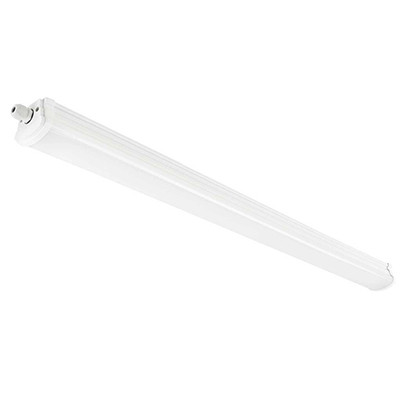
Linear Lighting
Continuous light along a length
Linear pendants and surface-mount bars deliver uninterrupted LED output along a long straight line. Kitchen islands, workstations, dining tables, corridors — anywhere you need even task light over a length.
What linear lighting does differently
A linear fitting has no distinct bulbs. Instead, an integrated LED strip or rod runs the length of the fitting, delivering continuous light along the whole span. The effect is clean and architectural — no visible bulbs, no shadow gaps, just an even beam along the length.
Compare to a bar pendant, which has three to five distinct bulbs along a horizontal bar. Bar pendants have more decorative presence; linear fittings have a cleaner modernist feel. Both cover long surfaces effectively — the choice is aesthetic more than functional.
Where linear lighting is the right answer
Kitchen islands — a linear suspension above a kitchen island gives even task light across the full worktop length, with a sharp architectural form that suits modern kitchen design.
Long dining tables — tables over 1.8m benefit from a linear fitting that covers the whole length, rather than a single central pendant that leaves the ends in shadow.
Home office and studio workstations — a linear pendant over a desk gives shadow-free task light without the hot spot of a single desk lamp.
Hallways and corridors — wall- or ceiling-mounted linear fittings along the length of a corridor, providing continuous wash light without the visual interruption of multiple discrete fittings.
Commercial and hospitality spaces — linear lighting is the default in modern retail, restaurant and office interiors where the architecture calls for clean line-based lighting.
Suspended vs surface-mount vs wall
Suspended linear (pendant) — hung from the ceiling on cables, typically 60–90cm below the ceiling. The most decorative format. Works above kitchen islands, long dining tables and workstations.
Surface-mount linear — mounted tight to the ceiling with no drop. For lower ceilings and hallways where a pendant drop would crowd the space. Can also mount to walls for a vertical or horizontal wall wash.
Recessed linear — sunk into the ceiling for a near-invisible architectural effect. Requires ceiling cavity depth and is usually a new-build or major-renovation specification.
Lengths and output
Common lengths: 60cm (small workstations, short islands), 90cm (standard kitchen islands), 120cm (dining tables for 6), 180cm (long dining tables or large islands), 240cm (commercial and large-scale domestic). Custom-length linear fittings exist for specific architectural installations.
Output scales with length — a 1m linear fitting typically delivers 1500–2500 lumens; a 2m fitting 3000–5000+ lumens. For task lighting, aim for 500–700 lumens per metre of worktop or desk being covered. Over dining tables, 400–600 lumens per metre is comfortable.
Integrated LED — colour and dimming
Almost all linear fittings use integrated LEDs — the continuous strip is the whole point. Most are available in warm (2700K), neutral (3000K) or cool white (4000K), fixed at manufacture. Tuneable-white linear fittings shift along the warm-to-cool axis via a compatible dimmer or app.
Dimming works with compatible trailing-edge LED dimmers or smart controls. Check the product page — some integrated-LED linear fittings are fixed at full output, while others support smooth dimming across the full range.
For app and voice-controlled linear fittings, see the smart bar pendant range, which includes several linear-style smart pendants.
Installation
Linear pendants are usually heavier than standard bar pendants and longer than the existing ceiling rose. Installation should be done by an electrician, who will also confirm that the ceiling fixing can support the fitting's weight and length. For kitchen islands, the ceiling rose will usually need repositioning to centre the linear fitting over the island rather than the room centre.
Frequently asked questions
What's the difference between a linear pendant and a bar pendant?
A linear pendant has a continuous LED strip along its length — no distinct bulbs. A bar pendant has three to five separate bulbs along a horizontal bar. Linear is cleaner and more architectural; bar pendant has more decorative presence. Both cover long surfaces effectively.
How long should a linear pendant be?
Roughly 60–75% of the length of the surface below. A 2.4m kitchen island suits a 1.5–1.8m linear pendant; a 2m dining table suits 1.2–1.5m. Too short and the ends of the surface go dark; too long and the fitting dominates the room.
How high should I hang a linear pendant?
Bottom of the fitting 75–90cm above the island or tabletop. For kitchen islands where people sit at barstools, lean towards the higher end so the light doesn't glare at eye level.
Can the LED be replaced if it fails?
Usually no — the LED is integrated into the fitting and typically lasts 25,000+ hours (over 20 years at normal use). When it eventually fails, the whole fitting is replaced. This is the trade-off for the clean continuous-light form.
Are linear fittings dimmable?
Most are, but check the product page. Dimmable linear fittings need a compatible trailing-edge LED dimmer or a smart control system. Some fixed-output linear fittings are on/off only.
Related categories
- Pendant Lights — the full pendant range
- Bar Pendants — distinct-bulb alternatives for long surfaces
- Ceiling Lights — general ceiling-light range
- Smart Bar Pendants — smart-controlled linear pendant alternatives
- Under Cabinet Lights — linear task lighting for kitchen worktops