
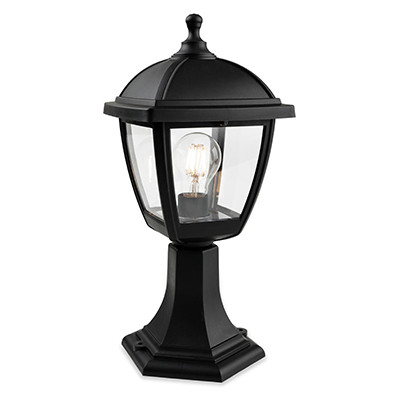
Post Top
Lantern on a post — the driveway classic
Post-top lights mount on a freestanding pole, bringing light to places that wall-mounted fittings can't reach. Front driveways, gate approaches, garden corners, pathway entrances.
When a post top is the right fitting
Post-top lights do one thing a wall light can't: bring outdoor light to positions away from the building. Most homes have plenty of walls to mount lights on, but the parts of the garden that actually need light — driveways, gate approaches, path junctions, boundary corners — are often nowhere near a wall.
Typical applications:
Front driveways and entrance gates — one or two post tops either side of the gate or along a driveway's length, marking the approach and providing light for parking and access.
Garden paths and corners — a single post top at a junction or focal corner, giving the garden a visual anchor at night.
Boundary marking — a series of post tops along a property edge or low wall, defining the boundary and providing general perimeter light.
Traditional front gardens — period properties with front gardens benefit from post tops that match the era of the house. Much more in keeping than modern wall-mounted alternatives.
Heights and post options
Post-top lights are sold either as complete units (lantern plus post) or as lantern heads fitted to a separately-purchased post. Standard heights:
Short post tops (50–90cm) — path marking and low-border lighting. Close to a bollard in function but with more decorative presence. See bollards for shorter alternatives.
Mid-height (1.2–1.8m) — the most common range. Driveways, garden corners, and pathway intersections. Puts the lantern at a height where it lights the surrounding area without glaring into people's eyes.
Tall posts (2m+) — driveway and gate approaches on larger properties, where the greater height spreads light over a wider area.
Lantern styles
Traditional glass lantern — four- or six-sided glass-panelled lantern with an ornate metal frame. The classic "Victorian street light" silhouette. Suits period properties and cottage gardens.
Modern geometric — clean-line square or cylindrical forms in matt black, bronze or brushed metal. Built for contemporary homes and driveways.
Simplified colonial — four-sided glass lantern with minimal ornamentation. Transitional styling that works on both period and modern properties.
Power, installation and groundwork
Hardwired post tops need a cable run from the house to the post, buried underground at regulated depth in armoured conduit. The post itself fixes to a concrete ground base or is set directly into concrete at install. This is significant groundwork and should be planned before any paving or landscaping goes in — retrofitting a post top after paving is a much bigger job.
Installation is always an electrician's job (Part P notifiable) and often also benefits from a groundworker or landscaper coordinating the concrete base.
Bulbs, sensors and smart control
Most post tops take a single E27 bulb inside the lantern, though some modern designs use integrated LEDs. Warm white (2700K) is the welcoming default; dusk-till-dawn photocell switching is common and avoids ever having to remember to switch on a post top at nightfall.
Frequently asked questions
How tall should a post top be?
1.2–1.8m for most driveway and garden applications. Shorter (50–90cm) for path marking. Taller (2m+) for larger driveways where wider light spread matters. Match the height to what the post top is lighting — taller for area coverage, shorter for decorative focal points.
Can I install a post top myself?
No. Buried cable runs, concrete post bases and hardwiring to the house circuit are all beyond DIY scope. Installation is an electrician's job and notifiable under Part P. A landscaper or groundworker often coordinates the concrete base alongside the electrician.
Do I need a separate photocell or timer?
Many post tops include a built-in dusk-till-dawn photocell that switches the light on automatically at nightfall. Models without can be wired to a wall-mounted photocell, a timer, or a smart switch. For front-garden post tops where you want reliable evening light, photocells are the simplest solution.
What material lasts longest?
Solid cast aluminium, powder-coated die-cast aluminium and solid brass are the most durable. For coastal properties, see coastal lighting — those fittings are spec'd for salt air.
Related categories
- Exterior Lighting — the full outdoor range and zone/IP primer
- Bollards — shorter post-style path lighting
- Exterior Wall Lights — wall-mounted alternatives
- Landscape Lighting — decorative garden-feature lighting
- Coastal Lighting — marine-grade post tops for seaside properties