
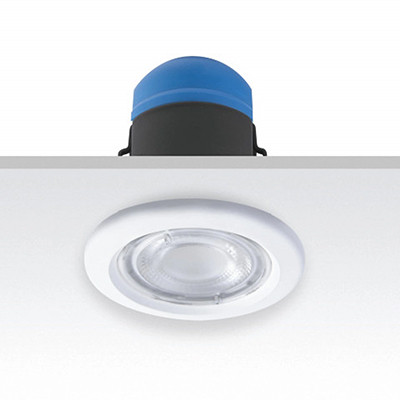
Recessed
Downlights built into the ceiling
Recessed downlights sink flush into the ceiling surface, throwing directional light down without any visible fitting. The default modern ceiling lighting for kitchens, hallways, bathrooms and open-plan living.
Why recessed downlights became the default
Three reasons, all practical:
Clean ceiling plane — nothing visible below the ceiling face except a small trim. Ceilings read as uncluttered, architectural, modern.
Even light distribution — multiple downlights in a grid give consistent illumination without the single-point brightness of a central pendant. No shadow corners, no glare zones.
Headroom preservation — nothing drops from the ceiling into the room. Makes lower-ceiling rooms feel taller and larger than they really are.
The trade-offs: installation requires cutting into the ceiling (needs cavity depth and access), and the fittings themselves are more visible during the day than flush alternatives — a "lots of holes in the ceiling" effect if over-specified.
Array design — getting it right
Recessed downlights work best as arrays, not as isolated fittings. Key rules:
Density — one downlight per 1–1.5m² of ceiling area, matched to the fitting's output. A 4m x 5m kitchen (20m²) typically takes 10–14 downlights.
Grid spacing — 80cm–1.2m between adjacent downlights, with 40–60cm clearance from wall edges. Avoid clustering in the ceiling centre.
Task-focused positioning — in kitchens, place downlights over worktops and islands, not centred in the middle of the room. This puts light where people work, not where they stand.
Matching the ceiling layout — in rooms with beams, bulkheads or steps in the ceiling, position downlights to sit cleanly within each section rather than fighting the architecture.
Fire-rated vs non-fire-rated
Recessed downlights cut through the ceiling's fire-resistant barrier. If there's a habitable room above the downlight (bedroom, living room, kitchen), the fitting must be fire-rated to restore that barrier in case of fire below.
Fire-rated downlights have intumescent material that expands in heat, sealing the opening. They're labelled 30, 60 or 90 minutes depending on the fire-resistance rating. Look for this rating on the product page — for upstairs ceilings and any downlight where there's a habitable room above, fire-rated is non-optional.
If the downlight is in a top-floor ceiling with only roof space above, fire-rating is less critical, but many electricians will still specify fire-rated for consistency.
Bathroom and IP-rated recessed
Standard recessed downlights are not IP-rated and are not safe in bathroom zones. For bathroom recessed lighting, use the bathroom spotlight range — every fitting there is IP-rated appropriately, with IP65 available for Zone 1 (above the shower or bath).
Bulbs, dimming and colour temperature
Most recessed downlights take GU10 bulbs — mains-voltage, widely available, easy to swap. GU10 LEDs are the dominant choice, with warm (2700K), neutral (3000K) and cool (4000K) options widely available, plus dimmable and smart variants.
A growing proportion of modern slim-bezel recessed downlights use integrated LEDs — the LED is built in, can't be replaced, but typically lasts 25,000+ hours and is often tuneable white.
For kitchens, 3000–4000K is the right colour temperature — clean enough to read as task lighting. For living rooms and bedrooms, 2700K warm white is more comfortable. For mixed-use open-plan spaces, tuneable-white integrated LED downlights let you shift the colour temperature as the room changes use through the day.
Installation
Recessed downlight installation requires cutting the ceiling surface, routing cable to each fitting, and proper electrical termination. All of this is notifiable under Part P and must be done by an electrician. Even like-for-like replacement is often notifiable given the fire-rating and IP-rating implications.
Frequently asked questions
Do all my upstairs downlights need to be fire-rated?
If there's a habitable room above the downlight, yes. Fire-rated downlights maintain the ceiling's fire-resistance rating in case of fire below. On a top floor with only loft space above, fire-rating is less critical but often still used for consistency.
How many recessed downlights do I need?
One per 1–1.5m² of ceiling area, evenly spaced in a grid. A 4m x 5m kitchen typically takes 10–14 downlights. Over-specifying creates a "swiss cheese" ceiling effect; under-specifying leaves shadow zones.
What bulb does a recessed downlight take?
Most take GU10 (mains-voltage, bi-pin, widely available). Slimmer modern designs often use integrated LEDs that can't be swapped. Check the product page before ordering bulbs.
Can I put recessed downlights in my bathroom?
Only IP-rated ones, from the bathroom spotlight range. Standard interior recessed downlights are not safe or compliant in bathroom zones.
Can I install recessed downlights myself?
No. Cutting the ceiling, routing cables through the cavity, ensuring correct fire-rating and electrical termination — all notifiable under Part P and must be done by a qualified electrician.
Related categories
- Ceiling Lights — general ceiling lighting range
- Surface Downlights — surface-mount alternatives for solid ceilings
- Spotlights — fixed, adjustable and track spotlights
- Bathroom Spotlights — IP-rated recessed for bathrooms
- Smart Recessed Lights — app-controlled recessed downlights