
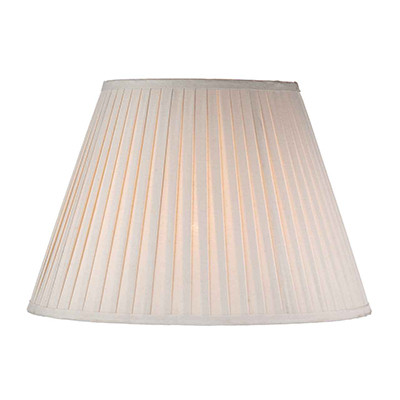
Shade Only
A new shade changes the whole room
Swap a tired shade for something sharper and the light, the colour and the whole feel of the room shifts. Fabric, pleated, glass or metal — in most popular fittings and sizes.
Choosing the right lamp shade
A lamp shade does two jobs at once: it shapes how the bulb throws light into the room, and it finishes the fitting visually. Get the sizing or the material wrong and the whole piece feels off — too dark, too glary, or visually top-heavy.
Our range covers shades for pendants, table lamps and floor lamps, from soft fabric drums that wash light evenly across a living room, to crisp pleated empires that suit a traditional bedside lamp, to bold metal coolies that work as a design statement on a modern bar pendant.
Shade shapes at a glance
Drum — straight-sided cylinder. Modern, clean, and by far the most versatile. Works on pendants, table lamps and floor lamps and suits almost any interior. Empire — tapered, wider at the bottom. The classic lamp-shade shape, slightly more traditional, flattering on bedside and console lamps. Coolie — wide, shallow taper. Great on pendants where you want to throw light downwards over a dining table. Bell — gently curved sides, often pleated. The most decorative shape, at home on crystal and brass table lamps.
Sizing rules that usually work
For a table lamp, the shade height should roughly match two-thirds of the base height, and the shade should be about 1.5 times as wide as the base at its widest point. For a pendant over a dining table, pick a shade diameter around 30cm less than the shortest side of the table — big enough to feel intentional, small enough not to crowd.
Understanding shade fittings
The single most important thing to get right is the fitting. A beautiful shade that won't mount on your lamp or pendant isn't useful to anyone. There are four common fitting types to know:
Easy-fit (European fitter)
A sprung clip that snaps directly onto a standard ES/E27 or B22 bulb holder, usually with a 40mm or 42mm collar. Most modern pendant shades use this fitting — if you're replacing a shade on a bare pendant cord with a ceiling rose, this is almost certainly the one you need. No extra gallery or harp required.
Duplex (UNO fitter)
A 39mm metal ring that sits on a gallery above the bulb, then secures with a finial. Common on traditional lamps and chandeliers with upward-facing candle bulbs. You'll need a gallery on the lamp itself — check what your existing shade is sitting on before you buy a replacement.
Spider fitter
A three-armed metal bracket that rests on a harp — the U-shaped wire frame you find above the bulb on many traditional-style table lamps. Secures with a finial at the top. If your existing shade has a harp underneath, you need a spider fitting.
Clip-on / ring
A small metal clip that grips directly onto a candle-style bulb, usually SES/E14. Used on chandelier arms and small wall lights. Quick to fit, but only works on slim candle bulbs — not suitable for larger ES bulbs or LEDs that don't have a compatible shape.
If you're not sure which fitting you have, the quickest test is to look at the top of your existing shade: a sprung clip on a 40mm ring is easy-fit, a gallery collar is duplex, three wire arms crossing over the bulb is spider, and a single ring that clips to the bulb itself is clip-on.
Matching shades to rooms
Fabric shades — linen, cotton, silk — diffuse light softly and warm the colour temperature slightly. Ideal in bedrooms, living rooms and anywhere you want a relaxed glow. Paper and opal glass do a similar job with a cleaner, brighter feel.
Metal, mirrored and heavily patterned shades throw most of the light up and down rather than through the shade itself. They make a design statement, but they're not the right choice if you want the shade to light the whole room — pair them with other light sources or use them over a specific zone like a dining table or kitchen island.
Dark shades (black, navy, deep grey) absorb a lot of light. They look striking, but budget for a higher-output bulb and expect more of the light to come from the top and bottom of the shade rather than through it.
Bulbs, heat and fabric shades
Modern LED bulbs have made shade choice much safer. Because LEDs give off very little heat, fabric, paper and silk shades can now be used with higher-lumen bulbs than was ever practical with old halogens or incandescents. Still, check the maximum wattage printed on the shade or lamp — it's usually there as a guide.
For warm, comfortable living-room light, look for bulbs around 2700K. For kitchens, bathrooms and workspaces, 3000K–4000K gives a cleaner, more functional feel. Most of our shade-friendly lamps and pendants are dimmable when paired with a dimmable LED bulb and a suitable dimmer switch — check the product page for confirmation.
Frequently asked questions
How do I measure a shade for a replacement?
Measure three things on your existing shade: the bottom diameter (widest point), the top diameter (narrowest point), and the slant height down the side. Also note the fitting type. Those four numbers are enough to find a direct replacement or a close match in the same style.
Can I use any shade on my pendant light?
Only if the fittings match. Most modern pendants use an easy-fit shade that clips onto the bulb holder, so any easy-fit shade will work. If you have an older fitting with a gallery or a chandelier arm, check carefully — a spider or duplex shade will not mount on an easy-fit pendant, and vice versa.
Will a new shade work with my smart bulb?
Yes, provided the bulb fits the socket and the shade has enough internal clearance. Smart bulbs are usually slightly larger than a standard LED, so check the shade's internal height. Fabric and paper shades work fine with smart bulbs because LEDs run cool.
Can I fit a new shade myself?
In most cases, yes. Easy-fit, spider and clip-on shades swap in seconds with the power off at the wall — no electrician needed. Only call an electrician if you're also replacing the ceiling rose, pendant cord or the fitting itself.
Why does my new shade hang crooked?
Usually the bulb or the ceiling rose is the culprit, not the shade. An easy-fit shade sits on the bulb holder — if the holder is tilted, the shade will tilt with it. Turn the power off, loosen the rose slightly, straighten the cord and retighten. If the shade itself is warped, it's worth returning rather than trying to correct it.
Are there shades that work in a bathroom?
Standard fabric, paper and silk shades are not suitable for bathrooms — they're not rated for moisture and usually sit in a zone that requires an IP-rated fitting. For bathrooms, choose a complete IP-rated fitting from our Bathroom Lighting range rather than adding a shade to an unrated pendant.
Related categories
- Easy Fit Pendants — full pendant fittings with an easy-fit shade included, if you'd rather replace the whole piece
- Shaded Pendants — pendants sold complete with shade, matched by the manufacturer
- Table Lamps — bases to pair with a new shade, or complete lamps with shade included
- Floor Lamps — taller fittings that take larger drum, coolie and empire shades
- Lighting Accessories — ceiling roses, pendant cords, lampholders and galleries