
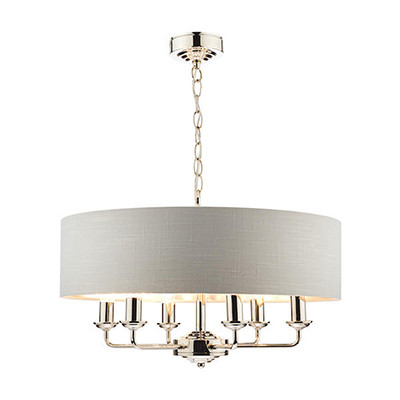
Shaded Pendant
Pendants sold complete with a matched shade
Shade and fitting designed to work together, shipped as a single piece. No picking the shade separately, no guesswork on fitting type — just order and install.
Shaded pendants — what's different
A shaded pendant is a pendant light sold complete with its shade as a single matched unit. The shade is designed for the fitting, the fitting is wired for the shade, and the result is a cohesive piece — rather than a base and a shade picked separately and hoped to match.
The advantages are practical rather than decorative: you don't need to measure shade fittings, check cap-type compatibility, or guess at proportions. The manufacturer has made those decisions. For anyone who wants a pendant that looks finished out of the box, this is the right route.
When a shaded pendant is the right choice
You want a specific look — designers and lighting brands curate shaded pendants as complete compositions. Buying the matched set gets you the intended look rather than approximating it with a base-plus-shade combination.
You're not confident picking a separate shade — sizing a shade to an unshaded pendant base means measuring the fitting, checking the shade ring type, and matching the proportions. Shaded pendants remove all that.
You want traditional or transitional styling — most shaded pendants sit in the traditional-to-transitional range. For strictly modern or industrial pendants, shade-less exposed-bulb designs are usually more appropriate.
You want a fabric shade — pendant-specific fabric shades are almost always sold as part of a shaded pendant, rather than as separate shades. Buying the full pendant is often the only way to get a specific fabric shade design.
Shade materials in this range
Fabric shades — cotton, linen and silk drums or empires, diffusing light softly with warmth. The most common shade material on shaded pendants. Works in living rooms, bedrooms and dining rooms.
Pleated shades — gathered fabric in a traditional silhouette. Characteristic of period and classic interiors, often paired with brass or crystal pendant hardware.
Glass shades — opal, smoked, textured or clear glass in various shapes. Cleaner than fabric, more directional downward throw. Works in kitchens, dining rooms and modern living spaces.
Metal shades — aluminium, brass, copper or powder-coated steel. Strong presence, throws most light downwards rather than through the shade. Industrial and modern styles.
Installation and bulbs
Shaded pendants install like any standard pendant — hardwired to the ceiling rose, with the shade typically pre-assembled or attached during install. Most take a single E27 or E14 bulb, with some larger shaded pendants taking multiple bulbs inside a single shade for higher output.
LED bulbs are the right default — running cool, long-life, and available in warm white (2700K) or neutral (3000–4000K). Fabric and pleated shades particularly benefit from LED, which eliminates the heat build-up that used to limit bulb wattage in fabric fittings.
Frequently asked questions
Can I change the shade on a shaded pendant?
Sometimes. If the shade uses a standard easy-fit or duplex fitting, you can swap it for a compatible shade from our shade range. If it's a custom-fit shade designed specifically for that pendant, swapping isn't practical — you'd be back to picking a separate base and shade.
Is a shaded pendant the same as a single-light pendant?
A shaded pendant is one type of single-light pendant — specifically one sold with the shade included as a matched unit. Other single-light pendants are sold as base-only (for use with a separately purchased shade) or as shade-less designs (exposed bulbs, glass globes, decorative cages).
Will a fabric-shaded pendant give enough light?
Fabric shades diffuse the light softly, so less light reaches the floor than with a clear or metal shade. For task-heavy rooms (kitchens, home offices), pick a clear glass or metal-shaded pendant. For living rooms and bedrooms where diffuse warmth is the goal, fabric is the right choice.
Do shaded pendants work with smart bulbs?
Yes, provided the cap matches (usually E27) and the shade has enough internal clearance for the slightly larger smart bulb. Fabric and pleated shades work fine with smart LED bulbs — they run cool enough not to damage the shade material.
Related categories
- Pendant Lights — the full pendant range
- Single Light Pendants — all single-light pendants including unshaded
- Shade Only — replacement shades and standalone shades
- Easy-Fit Pendants — clip-on shade pendants
- Tiffany Pendants — stained-glass shaded pendants