
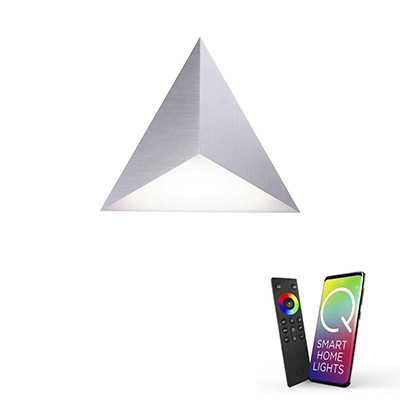
Smart Wall Lights
Wall lights with app and voice control
Smart interior wall lights — bedside readers, hallway lights and accent fittings with integrated smart control. Dim and schedule without a wall dimmer, control by voice.
Where smart wall lights earn their place
Wall lights are on and off several times a day in most homes, often at different brightnesses — dim bedside readers at night, bright hallway lights for morning use, low-level mood lighting for evenings. Smart control lets the same fittings do all three jobs without needing separate dimmers or dedicated circuits:
Bedside readers — voice-activated on/off without fumbling for a cord switch. Schedule a "wake up" ramp that gradually brightens to simulate sunrise. Dim via app without climbing out of bed to reach a wall dimmer.
Hallway and stairwell wall lights — dusk-till-dawn automation, scheduled dimming through the night, voice control for hands-full moments. Particularly useful in stairwells where reaching for a switch mid-stairs isn't safe.
Accent wall lights — flanking a fireplace, a mirror or artwork. Scene-controlled to match the room's evening mood.
Bedside readers where you want different brightness each side — partner reading late while you sleep. Independent app control on each fitting, no disturbing the other side of the bed.
Smart fitting vs smart bulb in a wall light
Wall lights are one of the formats where smart bulbs often work better than integrated smart fittings:
Smart bulb in a standard wall light — swap an E14, G9 or E27 bulb for a smart one. Quick, cheap, works with existing fittings. Preserves the decorative wall light itself. Usually the right approach for upgrading existing wall lights.
Integrated smart wall fitting (this range) — the electronics are built into the fitting. Cleaner integration, usually with tuneable white across a wider range, no visible bulb. Best for new wall-light installations where you're specifying the fitting fresh.
Scheduling and automation — the wall light's best trick
Wall lights benefit uniquely from scheduling:
Wake-up simulation — bedside wall lights that brighten gradually over 30 minutes before an alarm, from 1% to 100%, shifting from warm amber to cooler morning light. More pleasant than a shock-brightness alarm clock.
Sleep wind-down — bedside lights that automatically dim to warm amber at 10pm, then off at 11pm. No "just one more page" at full brightness.
Dusk-till-dawn hallway lighting — hallway wall lights that turn on at sunset at 20% brightness and off at sunrise, giving safe overnight navigation without flooding the house with light.
Most smart wall lights support these schedules natively in their paired app, or via routines in Alexa, Google Home and Apple HomeKit.
Bathroom smart wall lights
Standard smart wall lights are not IP-rated for bathrooms. For smart bathroom wall lighting, use IP-rated fittings from the bathroom wall light range, or use standard IP-rated bathroom wall fittings with smart bulbs inside. Smart control via app or voice works either way.
Wall switch and dimmer rules
Same rule as other smart fittings: don't install with an existing wall dimmer. Replace any dimmer in the circuit with a plain on/off switch. All dimming happens through the app, voice, or a compatible smart switch replacement.
For wall lights with pull-cord or integrated fitting switches, those continue to work — they're the physical on/off for the individual fitting and don't interfere with the smart electronics.
Frequently asked questions
Can I use smart wall lights in a bathroom?
Only if they're IP-rated for bathroom zones. Standard smart wall lights aren't IP-rated. For bathroom use, pick an IP-rated fitting from the bathroom wall light range or use standard IP-rated bathroom wall fittings with smart bulbs inside.
Do smart wall lights work with pull-cord switches?
Yes — the pull-cord acts as a local on/off for the fitting. When the cord is in the 'on' position, the smart fitting is reachable by app or voice. Some people leave the cord on permanently and rely on app/voice for all control; others use the cord as a manual backup.
Can I have different smart wall lights on each side of the bed?
Yes, and this is one of the most popular applications. Each fitting has its own app identity — one side can be full brightness for reading while the other is dim-amber or off. Partners can set their own schedules independently.
Do I need a hub?
Most Wi-Fi smart wall lights connect direct to the router. Zigbee-based ones need a compatible hub (Hue Bridge, Echo with Zigbee). Product pages confirm the connectivity.
Related categories
- Interior Smart Lighting — the full smart interior range
- Wall Lights — non-smart wall light range
- Smart Light Bulbs — smart bulbs for existing wall fittings
- Bathroom Wall Lights — IP-rated wall lights for bathrooms
- Smart Exterior Wall Lights — outdoor smart wall alternatives