
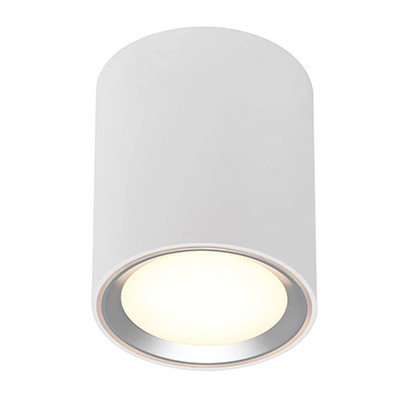
Surface Downlight
Downlight output without cutting into the ceiling
Surface-mount downlights deliver directional ceiling light where you can't recess into the structure — concrete ceilings, suspended ceilings, rental properties, or anywhere you'd rather not cut holes.
When a surface downlight beats a recessed one
Recessed downlights are the default for most modern interior ceilings — slim, flush with the ceiling, almost invisible. But recessing needs ceiling cavity depth (typically 50–100mm) and an accessible route for the cable. In many situations, that's not available.
Surface downlights give the same directional, spotlight-style light output but mount to the ceiling face rather than sinking into it. The fitting sits slightly proud of the ceiling — usually 3–8cm tall — but the installation is dramatically simpler.
The situations where surface downlights are the right answer:
Concrete and solid ceilings — cutting into a concrete ceiling slab isn't practical. Surface-mount downlights attach to the surface with anchors and carry cable through surface-mounted conduit or trunking.
Suspended ceilings with shallow plenum — some commercial and basement ceilings don't have enough cavity depth for standard recessed downlights. Surface mount works where there's no room above the ceiling for the housing.
Rental and temporary installations — where drilling large holes in the landlord's ceiling isn't an option. Small surface-mount fittings can be removed leaving only screw holes.
Retrofit renovations — existing plastered ceilings where full recessed installation would require cutting and re-plastering. Surface mount is much less disruptive.
Outbuildings and workshops — exposed-joist ceilings where there's nowhere to recess into.
Array layout
Like recessed downlights, surface downlights work best as arrays across the ceiling. Typical spacing:
Density — aim for one downlight per 1–1.5m² of ceiling area, matched to the fitting's output. A 4m x 4m room (16m²) typically takes 8–12 surface downlights.
Grid layout — space downlights evenly, 80cm–1.2m between adjacent fittings, keeping 40–50cm from the wall edges.
Task-focused zones — in kitchens, position downlights to throw light onto the worktop (not onto the person at the worktop, which creates shadows). Over an island, centre the array on the island length.
Fixed, adjustable and multi-head
Fixed surface downlights — beam aimed straight down from the ceiling. Simple, reliable, the default for general lighting.
Adjustable surface downlights — the head tilts within the fitting, letting you direct the beam towards a specific target. Useful for accent lighting — artwork, wall features, kitchen islands.
Multi-head bars and clusters — two, three or four adjustable heads on a single surface-mount base. Functions almost like a mini-track system; good for rooms where you need directional lighting in multiple directions from one fixing point.
For full track-based systems, see the spotlight range. Surface downlights sit between single fixed fittings and full track systems.
Bulbs, dimming and colour
Most surface downlights use GU10 replaceable bulbs; some modern slim designs use integrated LEDs. For kitchens and work areas, 3000–4000K cool white gives a cleaner, more functional feel. For living rooms and bedrooms, 2700K warm white is more comfortable.
Dimming works with dimmable GU10 LEDs paired with a trailing-edge LED dimmer. Integrated-LED surface downlights are dimmable only if the product page confirms.
Frequently asked questions
Why not just use recessed downlights?
Recessing requires ceiling cavity depth and the ability to cut into the ceiling surface. Many ceilings (concrete slabs, shallow suspended ceilings, rental properties) don't allow that. Surface mount gives the same directional output without the structural intrusion.
How much do surface downlights stick out from the ceiling?
Typically 3–8cm depending on the fitting. Slim modern designs are 3–4cm; larger adjustable heads and multi-head fittings are 6–8cm. Product pages list the depth.
Can I install surface downlights myself?
Replacing a like-for-like existing fitting is DIY with the power off. Installing a new array where there wasn't existing wiring requires an electrician — multiple cable routes, proper ceiling anchors, and Part P notification.
Are surface downlights as bright as recessed?
Yes — the difference is where the fitting sits, not how bright it is. Comparable surface and recessed downlights deliver similar lumen output. Pick by the mounting format that suits the ceiling, not by brightness concerns.
Related categories
- Ceiling Lights — the full ceiling-light range
- Recessed Downlights — cut-in alternatives for modern ceilings
- Spotlights — track-based and full directional lighting systems
- Flush Ceiling Lights — non-directional flush alternatives
- Under Cabinet Lights — surface task lighting for kitchen worktops
There are no products listed under this category.