
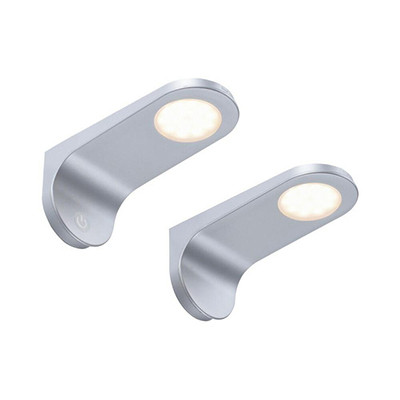
Under Cabinet Lights
Task lighting for the kitchen worktop
Under-cabinet lights mount to the underside of kitchen wall units, throwing clean bright light directly onto the worktop below. The practical lighting most kitchens are missing.
Why under-cabinet lighting matters
Kitchen worktops are where most of the actual kitchen work happens — chopping, reading recipes, plating food, prepping. And they're usually the worst-lit part of the room. The person standing at the worktop blocks the ceiling light, casting their own shadow on the very surface they're trying to use. A ceiling light array helps but rarely eliminates this.
Under-cabinet lighting fixes it directly. Mounted to the underside of the wall units, light falls onto the worktop below at exactly the right angle — from above the surface but behind the person standing at it. No shadow, no glare, task light where you actually need it.
Strip, puck and bar formats
LED strip — continuous flexible LED tape with adhesive backing, cut to fit the length of each wall unit. The cleanest, most even output format. Usually sold by the metre; matching drivers and connectors available.
LED bars — rigid aluminium strips with integrated LEDs, typically 30–90cm long. Mount with screws or adhesive. Easier to install and replace than strip but less flexible for non-standard-length units.
LED pucks — small circular fittings (typically 6–10cm diameter) mounted at intervals along the underside of the wall units. Older format; gives pool-of-light rather than continuous illumination. Largely superseded by strip and bar formats.
For most modern kitchens, LED strip or LED bars are the right choice — continuous light, clean look, hidden fittings.
Plug-in vs hardwired
Plug-in under-cabinet lighting — connects via a transformer to a standard wall socket. Quick to install, no electrician needed, suits rental and retrofit situations. Usually more visible cable work than hardwired.
Hardwired under-cabinet lighting — wired directly into the kitchen circuit, usually via a fused spur. Cleaner finish (no visible transformer or cable), integrated wall switching, but requires electrician installation. Right for new kitchens and major renovations.
Most hardwired installations run a transformer in a concealed position inside an adjacent wall unit, with low-voltage cables routing to the strip or bar fittings below. The strip/bar fittings themselves are usually 12V or 24V low-voltage, not mains.
Colour temperature
Under-cabinet lighting is task lighting, so cooler colour temperatures work well:
3000K (warm-neutral) — the comfortable default. Clean enough to read as functional, warm enough not to clash with the kitchen's general ambient warm white.
4000K (neutral-cool) — crisper, more clinical feel. Right for kitchens where precision matters — food prep, reading fine print on packaging, detailed work.
5000K (cool daylight) — very bright, sharp task light. Sometimes too clinical for residential kitchens; more common in commercial contexts.
Tuneable-white under-cabinet lighting lets you shift between warm and cool — useful if the kitchen is open-plan and the lighting needs to match the mood of the surrounding space through the day.
Controls and dimming
Most hardwired under-cabinet lighting is wall-switched, often as part of the kitchen's main circuit. Independent control — switching the under-cabinet separately from the ceiling lights — is worth specifying if you can. The under-cabinet often serves a different purpose (evening ambient vs task use) than the main ceiling lighting.
Dimming lets you drop under-cabinet lighting to gentle ambient levels for evening use — perfect for a relaxed kitchen mood. Pair with a trailing-edge LED dimmer or a smart dimmer for scene control.
Installation tips
Position close to the front edge of the wall unit — mounting at the back or middle of the unit leaves the front edge of the worktop under-lit. Aim for the LED's front edge to sit 3–5cm behind the front face of the cabinet.
Use matching segments per unit — one continuous strip across multiple units is cleaner than short strips at different heights.
Plan the transformer and driver location — hardwired installations work best with the transformer hidden in the top of a wall unit or above the cabinets, not visible below.
Consider an aluminium profile — some installations include a thin aluminium channel that houses the LED strip, hiding it from view and providing a clean reveal.
Frequently asked questions
Can I install under-cabinet lighting myself?
Plug-in versions, yes — they run off a standard socket via a transformer, no wiring needed. Hardwired installations need an electrician and are usually notifiable under Part P. Many people install plug-in versions as a retrofit, then upgrade to hardwired during the next kitchen renovation.
What colour temperature should I pick?
3000K (warm-neutral) is the comfortable default for most kitchens. 4000K if you want crisper, more functional task light. Avoid below 2700K (too warm for task) and above 5000K (too clinical for home use).
Are under-cabinet lights dimmable?
Most are, with a compatible trailing-edge LED dimmer or a smart dimming system. Some simple plug-in strips are fixed-output on/off only — check the product page before assuming dimmability.
Do I need a transformer?
For low-voltage (12V or 24V) strip lighting, yes — a transformer steps down the mains voltage to the strip's required voltage. The transformer is usually included with the strip as part of the kit. Mains-voltage LED bars exist but low-voltage is more common and generally safer in kitchen environments.
Related categories
- Linear Lighting — pendant and ceiling-mounted linear alternatives
- Ceiling Lights — general kitchen ceiling lighting
- Recessed Downlights — primary kitchen ambient lighting
- Spotlights — directional ceiling spotlights for kitchen task areas
- Bulbs — replacement bulbs for any cap type
There are no products listed under this category.