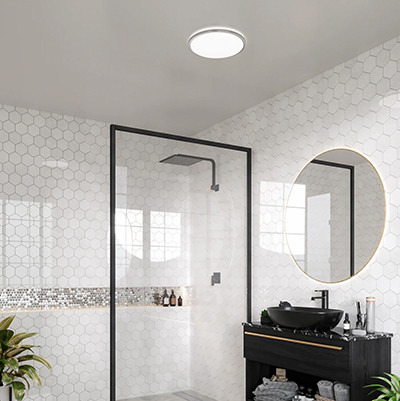
Bathroom
Safe, bright and actually flattering
Bathroom lighting has to do three things at once: stay safe near water, give you a face you recognise in the mirror, and make the room feel considered. The right fittings do all three.
Start with IP ratings and zones
Bathroom lighting is the one area where you cannot cut corners on the product spec. Water and electricity don't mix, and the regulations are strict — but straightforward once you know them.
Any room with a bath or shower is divided into zones based on proximity to water. Each zone has a minimum IP (Ingress Protection) rating that any light fitting installed there must meet or exceed. Every fitting in our bathroom range is labelled with its IP rating so you can match it to the zone.
Zones, explained simply
Zone 0 — inside the bath or shower tray itself. Fittings here must be IP67 or higher and low-voltage (12V). Usually only specialist LED strip or deck lights.
Zone 1 — directly above the bath or shower, up to 2.25m high. Fittings must be rated at least IP44, or IP65 if they're exposed to direct spray from the shower head. Ceiling lights and downlights directly above a shower sit here.
Zone 2 — a 60cm horizontal band around Zone 1, plus the area 60cm around and above a washbasin. Fittings must be at least IP44. Most bathroom wall lights beside a mirror sit here.
Outside zones — the rest of the bathroom. Standard fittings can technically be used, but most people still choose IP44+ for peace of mind given the steamy, wet environment.
Choosing lights for each zone
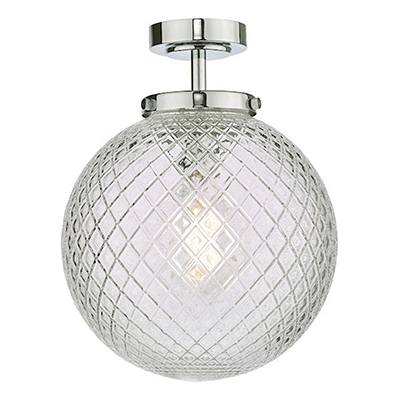
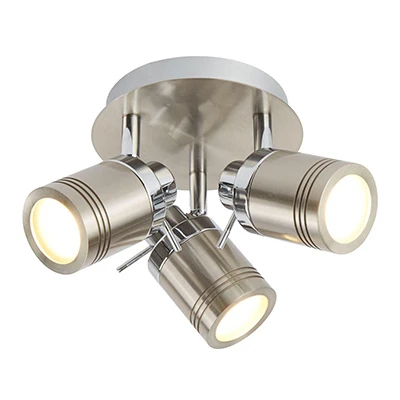
Over the shower or bath (Zone 1): IP65 downlights, IP65 flush ceiling lights, or a dedicated bathroom pendant rated for the zone. See our bathroom ceiling and bathroom spotlight ranges.
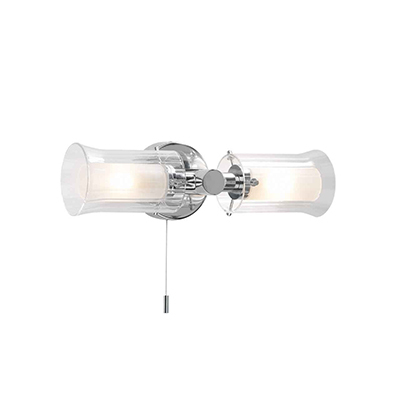
Around the mirror and basin (Zone 2): IP44 wall lights either side of the mirror give the most flattering face light; one light from above casts shadows under the eyes. Browse bathroom wall lights.
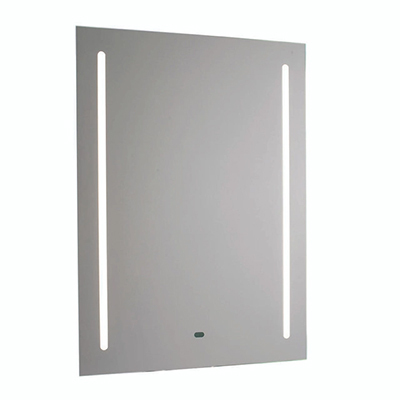
Mirror itself: illuminated LED mirrors combine the mirror and the light in one IP-rated unit, usually with tuneable white so you can switch between makeup-ready cool light and warmer bathroom-ambience light. See bathroom mirrors.
General ceiling light: a flush or semi-flush IP-rated fitting in the centre of the ceiling covers the rest of the room. Match colour temperature to the mirror lights if both are visible together.
Colour temperature matters more here
Bathroom lighting does double duty: ambient for the room and task for the mirror. Those two jobs want different colour temperatures.
For the mirror, 3000–4000K reads as neutral, close to daylight, and gives the most accurate skin tone for shaving, makeup and grooming. Warmer than 3000K makes skin look sallow; cooler than 4000K reads as clinical.
For general ceiling lighting, 3000K is usually the right balance — clean enough to feel fresh, warm enough not to feel like a hospital. If the bathroom has a dimmer, a tuneable-white smart fitting lets you drop to 2700K for an evening bath and push to 4000K for morning routines.
LED, IP and long-term cost
Almost every modern bathroom fitting uses integrated LEDs — partly because LEDs make IP-rating much easier (fewer openings for moisture), and partly because bathrooms are exactly the place you don't want to be changing a bulb above a shower. Expect 25,000+ hours of life, which at typical bathroom usage is over 20 years.
The trade-off is that integrated-LED fittings can't have the bulb swapped — when the LED eventually fails, the fitting is replaced. For a bathroom, this is almost always the right choice: safer, sealed, and low-maintenance.
Frequently asked questions
What IP rating do I need above my shower?
IP65 for fittings directly above the showerhead, or IP44 as an absolute minimum if the fitting isn't in the direct spray zone. If in doubt, choose IP65 — it's safe for every zone above zone 0 and future-proofs the fitting if the shower layout ever changes.
Can I use a standard light fitting in a bathroom?
Only outside the zones — and even then, most electricians and building inspectors recommend an IP44-or-higher fitting given the humidity. Standard fittings in Zone 1 or Zone 2 aren't compliant with wiring regulations and invalidate home insurance.
Should the bathroom light be warm or cool white?
For the mirror, aim for 3000–4000K — neutral and flattering for skin tones. For general ceiling lighting, 3000K is the comfortable middle ground. If the bathroom is used late at night, a tuneable-white fitting that drops to 2700K after dark feels more relaxing.
Do I need an electrician for bathroom lighting?
Yes. All bathroom lighting installation falls under Part P of building regulations and must be carried out by a qualified electrician (or signed off by a building control body). Even swapping an existing bathroom fitting like-for-like is a notifiable job in most cases.
Are LED bathroom lights dimmable?
Many are, but check the product page. A dimmable IP-rated LED fitting needs a compatible trailing-edge LED dimmer, ideally one rated for bathroom use. Mains-voltage dimmers cannot be mounted inside the bathroom zones — they usually go outside the door.
What's the best light for a bathroom mirror?
Lights on either side of the mirror at roughly face height, giving even light across the face with no shadows. A single light above the mirror works but casts shadows under the eyes. An illuminated LED mirror integrates both the mirror and the light into a single IP-rated fitting — the cleanest solution for most bathrooms.
Related categories
- Bathroom Ceiling Lights — flush and semi-flush IP-rated fittings
- Bathroom Wall Lights — IP44+ wall lights for around the mirror and basin
- Bathroom Spotlights — IP-rated downlights and directional spots
- Illuminated Bathroom Mirrors — integrated mirror + LED units with tuneable white
- Ceiling Lights — general ceiling lights for the rest of the home