
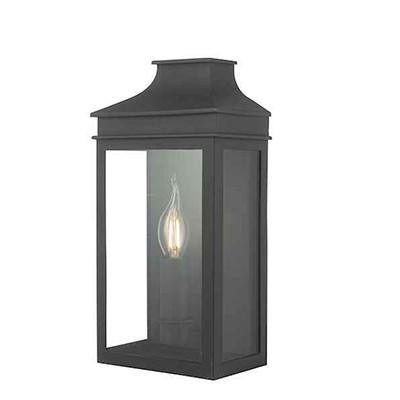
Exterior Wall Light
The outdoor light most houses actually need
Exterior wall lights handle the everyday jobs: either side of the front door, on the back porch, up the side passage. IP-rated, corrosion-resistant, engineered to survive what the weather throws at them.
Where exterior wall lights earn their place
A wall-mounted exterior light is the most common outdoor fitting in most homes, and with good reason. It's unobtrusive, it mounts to existing wall structure rather than needing a separate post, and it covers the places where outdoor light actually matters:
Front-door flanking lights — one or two lights either side of the front door. The single most-used exterior light in any home. Should be proportionate to the door, positioned at roughly eye-level when standing at the threshold.
Back door and garden access — one wall light above or beside the back door for evening garden use, bin-run safety and general security.
Porch, veranda and canopy — wall-mounted lights under a covered outdoor space. Often IP44 is enough under cover; IP65 is the safer spec for exposed positions.
Garage and side returns — functional wall lights along side passages, garage entrances and service areas.
Balcony and terrace — wall lights on the house-side of outdoor living spaces, softening the transition between interior and exterior.
Styles in this range
Traditional lantern-style — glass-panelled lanterns in black, bronze, brass or aged metal finishes. Suit period properties, cottages and traditional facades.
Modern up/down wall lights — architectural fittings that throw narrow beams of light up and down the wall, creating two soft bands. Clean, contemporary, increasingly popular on modern builds.
Box and bulkhead — simple rectangular or square fittings, often fully sealed. Functional rather than decorative; common on commercial builds and modern residential.
Sconce and decorative — shaped brackets with decorative elements, often with exposed or partly-exposed bulbs. Transitional styling for homes that want a bit of character without going fully traditional.
IP ratings and materials
IP44 is the minimum for any sheltered outdoor wall position (under a covered porch, for example). For exposed positions — facing the weather directly — IP54 or IP65 is safer and covers driven rain.
Material matters as much as IP rating for long-term durability. Powder-coated die-cast aluminium, solid brass, and marine-grade stainless steel all handle prolonged outdoor exposure. Cheaper pressed-steel fittings corrode quickly, especially in damp or coastal conditions. For seaside properties, see the dedicated coastal lighting range.
Bulbs, sensors and smart control
Most exterior wall lights take E27 or GU10 bulbs; a growing number use integrated LEDs with 25,000+ hour life. Warm white (2700K) is the welcoming default for front-door lights; 3000–4000K gives a cleaner, more functional feel for back and side returns.
Two features worth considering:
PIR motion sensor — the light turns on only when movement is detected. Right for back gardens, side returns and security-focused positions where always-on would be wasteful.
Dusk-till-dawn photocell — switches on automatically at nightfall and off at dawn. Ideal for front-door lights where you want reliable evening illumination without manual control.
For app, voice and schedule control, see the smart exterior wall light range.
Frequently asked questions
What IP rating do I need for a wall light on my house?
IP44 is the minimum for sheltered positions (under a porch, overhang or canopy). IP54 or IP65 for fully exposed walls facing the weather. If in doubt, IP65 is safe in every outdoor position and future-proofs the install if the surroundings ever change.
How high should a front-door wall light be mounted?
Roughly 160–180cm above the ground — eye-level when standing at the threshold. Lower and the light shines into people's faces as they approach; higher and the beam misses the immediate step.
Do I need an electrician?
Yes for any hardwired installation. Outdoor electrical work is notifiable under Part P, and cable runs outside need to meet specific depth and protection requirements. Plug-in wall-mount alternatives exist but are less common — see portable lighting.
Which materials last longest outdoors?
Marine-grade stainless steel, solid brass, and powder-coated die-cast aluminium are the most durable. Avoid pressed steel and untreated iron for anything exposed — they rust within a year or two, especially near the coast.
Related categories
- Exterior Lighting — the full outdoor range and zone/IP primer
- Exterior Ceiling Lights — flush porch and soffit fittings
- Exterior Spotlights — directional wall-mounted security lights
- Floodlights — high-output wide-beam security lighting
- Smart Exterior Wall Lights — app-controlled outdoor wall lights
- Coastal Lighting — marine-grade fittings for seaside properties