
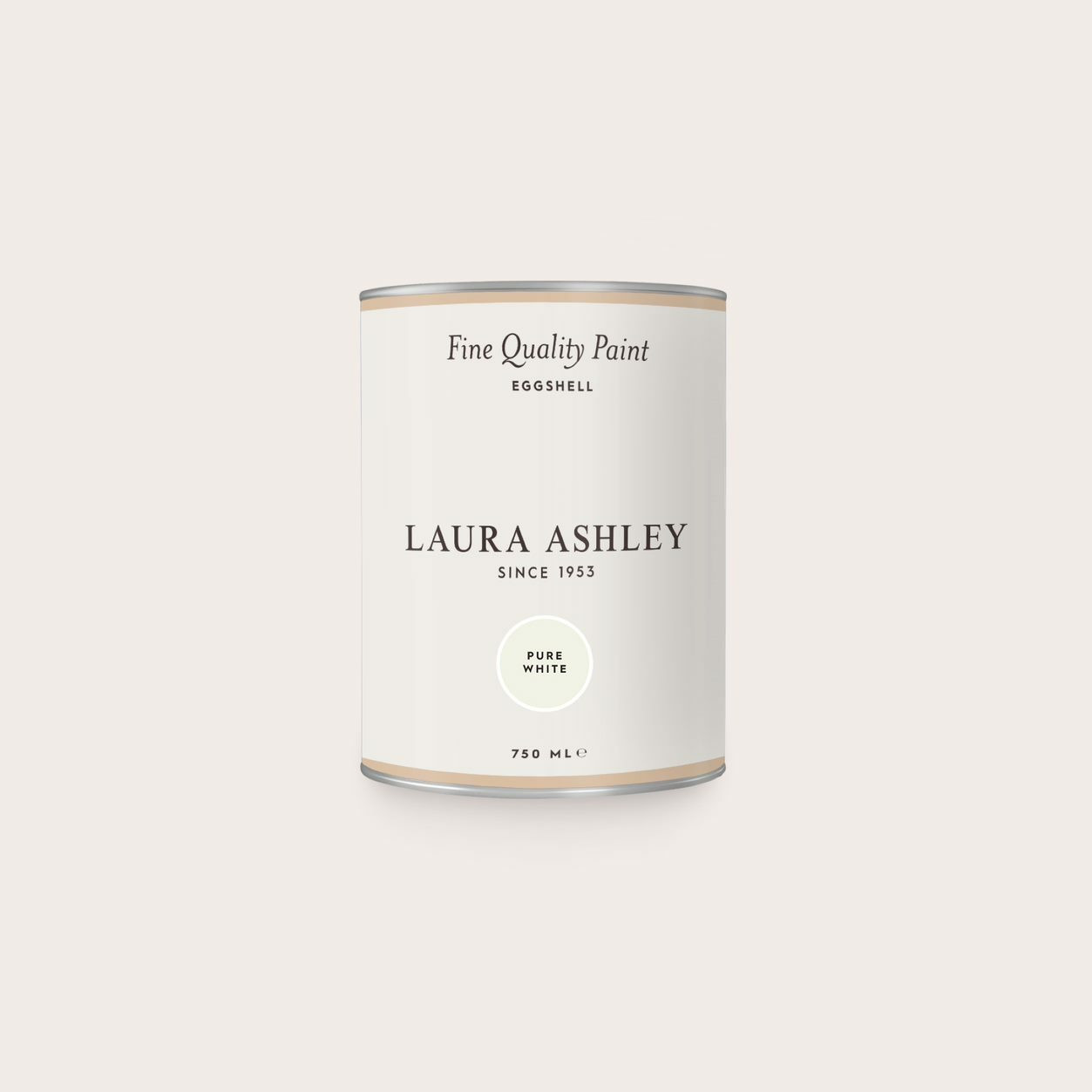
Laura Ashley 750ml Eggshell Paint
Interior eggshell for woodwork and durable finishes
750ml Laura Ashley eggshell — low-sheen interior paint for woodwork, doors, trim and high-traffic walls. More durable and wipeable than matt emulsion.
What eggshell is for
Eggshell sits between matt and gloss in terms of sheen. The finish has a subtle shine (roughly matching an eggshell, which is where the name comes from) that gives it practical properties matt emulsion doesn't have:
Wipeable and cleanable — eggshell tolerates damp-cloth cleaning. Matt emulsion can mark or lose colour when cleaned. This matters for anywhere that accumulates marks (skirting, trim, around door handles, below dado rails).
Durable under contact — eggshell stands up to furniture contact, knocks, scuffs and everyday wear. Matt marks more easily.
Tolerates moisture — eggshell handles occasional condensation and humidity better than matt, though for dedicated bathroom use kitchen and bathroom paint is still the right choice.
Slight sheen brings out detail — eggshell's subtle shine reveals mouldings, carved detail and grain in a way that flat matt doesn't. Part of why it suits woodwork.
Where eggshell works
Skirting boards — the single most common application. Low sheen that wipes clean when skirting gets scuffed.
Architraves and door frames — around doors where hands, bags and furniture make contact.
Doors — internal doors, cupboard doors, wardrobe doors. Eggshell is the interior-door standard finish.
Dado rails and picture rails — period trim that benefits from the subtle detail-revealing sheen.
High-traffic hallway and stairwell walls — where matt would scuff too easily.
Kitchen cabinet doors — though dedicated cabinet paint is often more durable still. Eggshell works for light use.
Built-in furniture — fitted wardrobes, bookshelves, window seats.
Radiators — though specialist radiator paint exists, standard eggshell works on radiators provided they're cool when painted.
Where eggshell isn't the right call
Main walls and ceilings — matt emulsion is usually better. The slight sheen of eggshell can highlight wall imperfections that matt hides.
Bathrooms (as main wall paint) — use kitchen and bathroom paint for bathroom walls. Eggshell works on bathroom woodwork (skirting, door frames) but isn't optimised for moisture-resistance.
Kitchens (as main wall paint) — same; kitchen/bathroom formulation handles cooking conditions better.
Exterior surfaces — use exterior eggshell outdoors; interior eggshell isn't weatherproof.
Coverage and application
750ml Laura Ashley eggshell covers roughly 10m² per coat on primed wood. That's enough for:
Skirting boards — around 30–40 metres of standard skirting per 750ml tin per coat.
Door frames — 3–5 door frames per tin per coat.
Internal doors — 2–3 doors per 750ml per coat (both sides).
Always apply two coats on wood — one coat shows brush marks and doesn't build to a proper durable finish. Sand lightly between coats with 240-grit for the smoothest finish.
Eggshell dries slower than matt — touch-dry in 2 hours, safe to recoat after 6–8 hours. Allow the first coat to fully cure before the second, particularly on doors that will be handled.
Preparation for wood
Wood preparation matters more than the paint itself:
Clean and degrease — wipe with sugar soap, particularly on doors and skirting that have accumulated hand grease.
Sand smooth — 180-grit for previously painted wood; 120-grit for bare wood or rough surfaces. Remove all sanding dust.
Prime bare wood — new wood, sanded-back wood, or any wood exposed to bare timber needs a wood primer before eggshell top coats.
Fill holes and gaps — wood filler for holes and scratches; decorator's caulk for gaps along skirting-to-wall joins.
Mask adjacent surfaces — decorator's tape along walls, carpets and floors to keep eggshell off where it's not wanted.
Frequently asked questions
Do I need to sand between coats?
Light sanding with 240-grit between coats gives the smoothest finish, particularly on doors and flat surfaces where brush marks are more visible. For skirting and less-visible trim, sanding between coats is optional.
Can I paint over gloss with eggshell?
Yes, provided the gloss is sanded to break the shine (220-grit usually) so the eggshell has something to grip. Unsanded gloss surfaces are too slick for good adhesion.
Is eggshell suitable for radiators?
Yes — paint with the radiator cold (off and cooled for several hours). Two thin coats rather than one thick. Allow 24 hours before turning the heating back on.
Related categories
- Laura Ashley Paint — full paint range
- Exterior Eggshell — outdoor equivalent
- Matt Emulsion — for walls and ceilings
- Paint Accessories — brushes and prep tools