
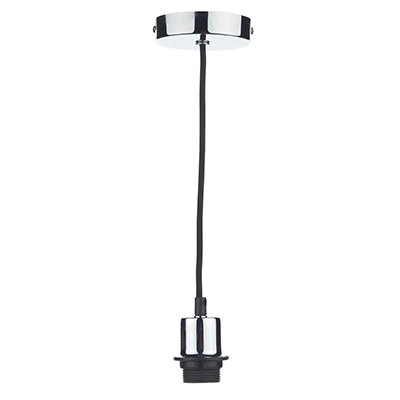
Lighting Suspensions
Cord sets for custom pendants
Cable kits, pendant cord sets and suspension hardware for building custom pendants or extending existing fittings. Fabric-braided, PVC, multi-core — with matching ceiling roses and lampholders.
What a suspension set does
A lighting suspension is the cord, cable grip, ceiling rose and lampholder assembly that connects a pendant shade to the ceiling. Sold as a complete kit or as individual components, suspensions let you:
Build a custom pendant — pair a cord set with a separately-chosen shade to create a pendant designed for your specific room.
Extend an existing pendant's drop — replace the existing cord with a longer one if the pendant is hanging too short for the room's ceiling height.
Shorten a pendant — trim the cord to bring a too-low pendant up to the right height.
Update the look — swap a standard white or black PVC cord for a fabric-braided cord that suits the style of the fitting better.
Replace a failed component — old cords, cracked ceiling roses and worn lampholders are all easily replaced with suspension components.
Cord styles
Fabric-braided cord — woven fabric wrapped around the electrical core, giving a textured appearance. Popular colours include black, white, natural linen, black-and-white twist, grey, mustard, burgundy. Suits industrial, vintage and Scandi styles especially well.
Plain PVC cord — smooth insulation in standard colours (black, white, clear). Modern, minimal, functional. The default on most off-the-shelf pendants.
Cloth-covered cord — cotton or silk outer layer over the insulation. Softer feel than fabric-braided; suits period and traditional styles.
Metal chain suspension — used for heavier chandeliers and lanterns where a soft cord isn't strong enough or the style calls for chain detail.
Clear cable — transparent PVC that visually disappears. Used for modern minimal installations where the cord should be as invisible as possible.
Components in a typical suspension
Ceiling rose — the plate that mounts to the ceiling and covers the cable entry. Usually includes the electrical terminal block.
Cord grip — inside the ceiling rose, holds the cord securely so weight from the pendant doesn't pull on the electrical terminals.
Cord/cable — the flexible conductor running from the rose to the lampholder. Available in different colours and styles.
Lampholder — the bulb socket at the bottom end of the cord. E27 (standard screw), E14 (small screw), B22 (bayonet), G9 and others.
Cord grip at lampholder — secures the cord to the lampholder so it doesn't pull free.
A complete suspension kit bundles all five in matching finish; buying individual components lets you mix and match.
Compatibility and spec
A few things to check before ordering:
Cord length — measure the drop you need (ceiling to bottom of intended shade position) plus 10–15cm for adjustment and termination. Cord sets typically ship in 1m, 1.5m, 2m or custom lengths.
Cap type (for lampholders) — match to the bulbs you intend to use. E27 is the most common for pendants.
Weight rating — cords are rated for a maximum load. A heavy pendant on an under-rated cord will stretch and eventually fail. For pendants over 2–3kg, check the cord's weight rating specifically.
Current rating — most standard-cord suspensions are rated for up to 3A (roughly 690W). For multi-bulb pendants with higher total wattage, confirm the cord handles the full load.
Fixings compatibility — ceiling roses come in various diameters and fixing-hole spacings. If replacing an existing rose, measuring before ordering saves trips back to the wall.
Installation
Replacing an existing pendant suspension is DIY with the power off at the consumer unit. Swapping a like-for-like cord set takes 10–20 minutes. Changes that involve modifying the circuit, moving the ceiling rose position, or installing new spurs need an electrician and are notifiable under Part P.
For bathroom or outdoor use, standard indoor suspensions are not safe or compliant — use only IP-rated components from the bathroom or exterior lighting ranges.
Frequently asked questions
Can I shorten a cord myself?
Yes, with the power off at the consumer unit. Unscrew the lampholder, trim the cord to the required length, re-strip the insulation and reconnect to the lampholder's terminal screws. For single-core cords (rare), the work is trivial; for multi-core flex, pay attention to which wire goes where. If unsure, an electrician will do it in 10 minutes.
What's the difference between a suspension and a cord set?
Terms overlap — "cord set" and "suspension" are often used interchangeably. A cord set usually refers to the cable-only component (cord plus grips, no rose or lampholder). A full suspension kit includes everything: rose, cord, lampholder, grips. Product pages confirm what's in the box.
Can fabric-braided cords handle heavy pendants?
Check the product's weight rating. Most fabric-braided cords are rated for standard pendant weights (up to around 3kg). For heavier feature pendants, chandeliers, or cluster fittings, use chain suspensions or cords specifically rated for higher loads.
Do I need a special cord for a smart bulb?
No — smart bulbs use the same E27 or E14 caps as standard bulbs. Any suspension with a matching lampholder works. Smart bulbs are slightly larger, so check the shade has enough internal clearance, but the cord and holder are unchanged.
Related categories
- Lighting Accessories — the broader accessory range
- Shade Only — shades to pair with suspension kits for a custom pendant
- Pendant Lights — complete off-the-shelf pendant fittings
- Bulbs — bulbs for every cap type
- Easy-Fit Pendants — shades that clip onto existing bulb holders, no cord replacement needed