
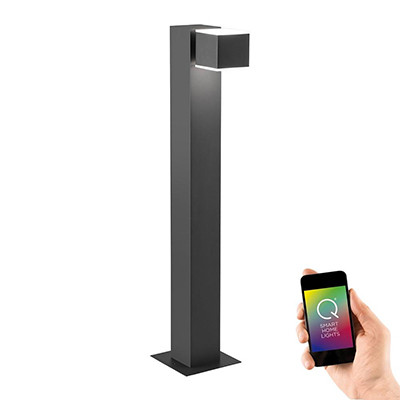
Smart Exterior Bollard Lights
Smart control for path and driveway bollards
Smart exterior bollards combine low-level path and boundary lighting with app, voice and schedule control. Reliable dusk-till-dawn, scene dimming, and away-from-home security simulation.
Why smart bollards beat standard ones
Standard bollards run on a photocell or wall timer — on at dusk, off at dawn, every day the same. Smart bollards give you much richer control:
True sunset-tracking schedules — the fitting knows actual local sunset and sunrise, adjusting through the seasons. No photocell false-triggers from passing headlights. No timer drift.
Dimming by time of day — full brightness at sunset when the driveway is in active use, dimmed to 20% after midnight when the bollards just need to mark the path. More subtle lighting, lower energy use, less light pollution.
Scene control for entertaining — "dinner party" scene turns the bollards brighter and coordinates with other garden lighting. "Movie night" dims them down alongside the patio lights.
Holiday / away simulation — randomised nightly patterns that mimic normal occupancy, coordinated with indoor smart lights. Much more convincing than static always-on security lighting.
Zone control across a run of bollards — a driveway with 6 bollards can be treated as one group, or split into "front drive" and "side path" zones, each independently controlled.
Where smart bollards are worth the extra cost
Smart bollards cost 20–40% more than equivalent non-smart models. That's worth it in specific situations:
Properties with multiple bollards — the scaling benefit grows with quantity. Five bollards individually controlled via app is genuinely transformative; a single bollard isn't worth the smart premium.
Households already using smart home — if you're already managing lights via Alexa or Google Home, adding outdoor bollards to existing routines is low-friction and valuable.
Security-focused installations — randomised away-from-home patterns and coordination with smart doorbells, locks and cameras adds real security value.
Hospitality and home entertaining — scene control of outdoor lighting during events gives hosting polish that standard bollards can't.
For households that just want path marking after dark, standard bollards are usually the better-value option.
Fitting formats
Smart bollards cover the same format range as standard bollards — heights from 30cm to 1m, downward-throw and omnidirectional variants, traditional and modern styling. The difference is the smart electronics inside the head and the connectivity module (Wi-Fi, Zigbee or Matter) for network integration.
Installation
Hardwired installation only — like standard bollards, smart versions require buried cable from the house, Part P notification, and electrician install. The smart setup happens via the companion app after power-on.
For Wi-Fi smart bollards, consider network coverage before install. A bollard 15–20m from the house with walls in between may struggle on Wi-Fi. Zigbee or Matter-based fittings mesh better at distance and are usually more reliable at garden edges.
Frequently asked questions
Can I still use a photocell with a smart bollard?
You don't need to — the smart fitting's scheduling handles dusk-till-dawn accurately via sunset tracking. Some smart bollards retain a photocell as a backup; others rely entirely on the smart schedule. Check the product page.
Will smart bollards work if the router is inside the house?
Usually, for nearby bollards (within 10–15m with no thick walls). For bollards further away or through multiple walls, consider a Wi-Fi extender near the outside wall, or use Zigbee/Matter-based bollards that mesh between each other for better reach.
Can I group multiple smart bollards into a single scene?
Yes. Smart-home apps (Alexa, Google Home, the manufacturer's companion app) let you group all your bollards — or split them into zones — and control them together or individually. A single voice command can switch the whole driveway array.
Are smart bollards still IP65-rated?
Yes — IP-rating applies to the fitting as a whole. The smart electronics sit inside the sealed housing. Look for IP65 minimum for standard path positions; IP67 for ground-adjacent or standing-water-prone positions.
Related categories
- Exterior Smart Lighting — the full smart outdoor range
- Bollards — non-smart bollard range
- Smart Exterior Wall Lights — wall-mounted smart outdoor alternatives
- Landscape Lighting — garden-feature alternatives
- Post Top Lights — taller freestanding outdoor lighting