
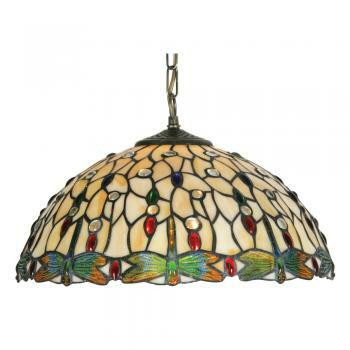
Tiffany Pendant Light
Stained glass hanging from the ceiling
Tiffany pendant lights — stained glass shades on cords or chains, throwing warm amber light downward onto dining tables, kitchen islands and entrance halls.
Why a Tiffany pendant changes the room below
Tiffany pendants work particularly well as dining-table and kitchen-island lighting. The warm amber light through coloured glass gives a specific quality to whatever's directly beneath — food looks richer, faces look warmer, the whole atmosphere of a dinner feels more considered.
The defining qualities of a Tiffany pendant:
Downward-focused warm light — Tiffany pendants typically have dome or conical shades that throw most light downwards. Ideal for lighting a specific surface (table, island, desk) with rich coloured warmth.
Day-time decorative presence — the stained glass shade is attractive even unlit. A Tiffany pendant is a design feature 24 hours a day, not just at night.
Rich-coloured projection — light passing through the shade colours the surrounding surfaces. On a pale dining table, you get gentle amber reflections; on a darker table, the effect is richer and more dramatic.
Traditional association — Tiffany pendants read as period, Arts-and-Crafts and traditional. They commit to that aesthetic in a way that a plain glass pendant doesn't.
Where Tiffany pendants work best
Dining tables — the single most common application. A single Tiffany pendant centred over a dining table gives warm amber light directly onto the surface. Works in traditional, transitional and eclectic dining rooms.
Kitchen islands — a single Tiffany pendant or a pair (for longer islands) over a kitchen island. Works especially well in farmhouse, country and traditional kitchens; less in strict modern kitchens.
Entrance halls — as a "first impression" pendant in period properties. Warm welcoming light that establishes the home's character immediately.
Breakfast bars and smaller eating areas — a single Tiffany pendant over a small dining surface works as both functional light and atmospheric accent.
Hallways with character — a Tiffany pendant breaks up a long hallway and adds decorative interest.
Sizing a Tiffany pendant
Size the shade to the surface below, not the room:
Over a dining table — shade diameter around 30cm less than the shortest side of the table. A 90cm round table suits a 60cm shade; a 150cm rectangular table suits an 80–100cm shade.
Over a kitchen island — for islands under 1.8m, a single 40–60cm shade. For longer islands, two smaller pendants spaced along the length, or a single larger shade.
In an entrance hall — proportionate to the hall. A small hallway suits a 40cm shade; a grand entrance hall can carry a 70–90cm statement piece.
Drop and ceiling height
Bottom of the Tiffany shade should sit 75–90cm above the dining table or kitchen island surface — high enough to keep sightlines clear across the table, low enough to throw focused light onto it.
Tiffany pendants work best on ceilings 2.6m or higher — the drop needs enough vertical space for the shade to sit at the right height without crowding the surface below. On 2.4m ceilings, consider a Tiffany semi-flush fitting instead.
Installation
Tiffany pendants hardwire to a standard ceiling rose like any pendant. Installation is Part P-notifiable and should be done by an electrician. Weight matters — larger Tiffany pendants (60cm+ diameter) can exceed 5kg and need a properly-rated ceiling fixing rather than a plasterboard rose.
Bulbs
Most Tiffany pendants take a single E27 bulb. Warm white (2700K) LED filament bulbs are the right default — preserves the amber character and runs cool.
For dining applications, look for 800+ lumens to give enough task light once the coloured glass has reduced output. For purely ambient entrance-hall use, 400–600 lumens is plenty.
Frequently asked questions
Will a Tiffany pendant give enough light for a dining table?
With an 800+ lumen warm LED bulb, yes — adequate task light for dining alongside the rich amber atmospheric effect. The coloured glass reduces light output compared to plain glass, so aim slightly higher on lumens than you would for a clear-glass pendant.
Can I fit a Tiffany pendant myself?
Replacing a like-for-like pendant is DIY with the power off at the consumer unit. For larger or heavier Tiffany pendants, or new installations, call an electrician. Installation is notifiable under Part P.
Are Tiffany pendants dimmable?
With a dimmable LED bulb and a trailing-edge LED dimmer, yes. Dimming works particularly well on a Tiffany pendant — at full brightness the fitting gives functional dining light; dimmed, it becomes a warm atmospheric centrepiece.
Related categories
- Tiffany Lighting — the full Tiffany range and heritage primer
- Pendant Lights — non-Tiffany pendant range
- Tiffany Easy-Fit Pendants — clip-on Tiffany shades for existing cords
- Tiffany Semi-Flush — shorter-drop Tiffany alternative
- Chandeliers — traditional chandelier alternatives